WHILE most businesses are shuttered, and office employees are working from home, the medical community must work hard to stay open to patients yet be tightly guarded by Covid-19 restrictions.
The challenge for doctors is how to continue treating their patients even though their clinics are closed. How can they “meet up” with patients without exposing themselves and their families to the risk of infection?
Technology provides a solution: teleconsultation.
It minimizes the need to travel and face to face contact, thus protecting both the patients and health professionals from exposure to health risks.
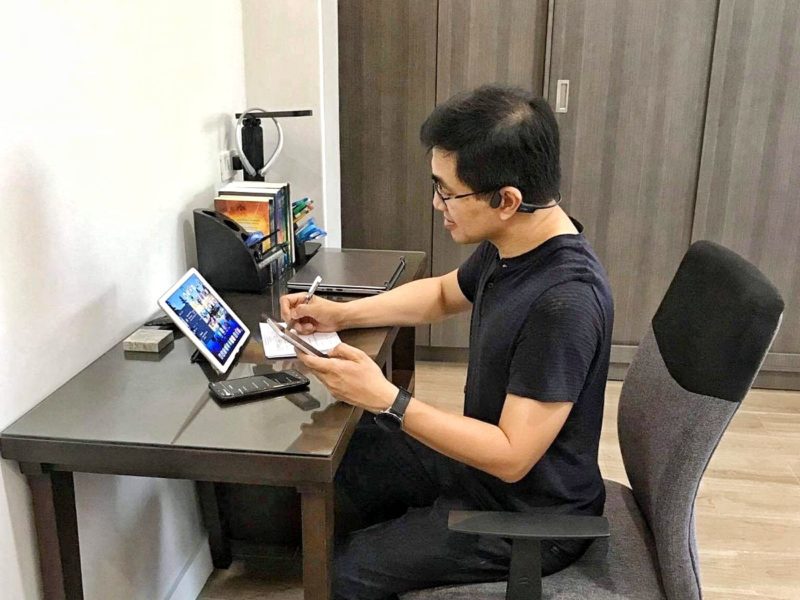
For the first time in her 30-year practice, Dr. Corazon Mata attends to patients remotely. She is in charge of the obstetrics and gynecology hotline for the Telekonsulta Service of the Northern Mindanao Medical Center (NMMC).
Every day, she fields queries from ob-gyn patients all over Region 10, which covers the provinces of Misamis Oriental, Misamis Occidental, Bukidnon, Camiguin, and Lanao del Norte.
With the rapid spread of Covid, other health cases have been overshadowed, with many hospitals like NMMC recording a significant drop in inpatient consultations at the emergency room and out-patient clinics.
The NMMC is a tertiary public hospital and one of the Covid referral centers in the region of 5 million.
“This is the main reason we decided to start the NMMC Telekonsulta Service,” says Dr. Aris Austria, Telekonsulta project leader. “We were concerned particularly for our patients with chronic conditions requiring long-term medical care. Every healthcare facility should not focus only on handling the Covid-19 crisis but also consider minimizing ‘collateral damage’ on non-Covid patients.”
The NMMC Telekonsulta Service targets noncritical cases and aims to provide a venue for patients to directly consult medical professionals through their mobile phones.
Smart Communications partnered with the hospital by providing them with LTE phones capable of unlimited texts and calls to all networks and data connection. Each phone was assigned to doctors handling a specific field of specialization, such as pediatrics, obstetrics, and gynecology, surgery or internal medicine.
Since the start of the project in late March, the NMMC doctors have collectively handled more than 400 consultations, sent out almost 200 electronic prescriptions, and facilitated around 50 referrals. They have also set appointments for actual clinic consultations for cases where a clinic visit is necessary.
“A good part of diagnosing a patient is doing a complete physical,” says Dr. Ramon Yap, an internist-gastroenterologist. “But I believe the majority of patients can be safely managed through teleconsultation, albeit some patients may have to be seen by a doctor in a clinic or referred to an appropriate institution like NMMC.”
The experience is new to his 17-year practice, but he says doctors have to adapt. “The threat to doctors is very real. We also have to think about protecting ourselves and our families, aside from trying to give comfort and healing to our patients. The limited resources that we have in our locality has made the practice of medicine very daunting and probably even unsettling.”
Dr. Peter Quiaoit, NMMC medical training officer, thanked Smart for making the out-patient department services “a phone call away” in the time of crisis.
“Smart is committed to providing innovative communications solutions that help fight the Covid pandemic. The NMMC has taken a new path, using technology to enable its doctors to treat patients despite the current restrictions. That’s why we are quite happy to support their initiative,” said Mon Isberto, Smart public affairs head. (PR)