CAGAYAN DE ORO CITY — A day before a highly anticipated hearing before the Department of Environment and Natural Resources (DENR), the legal battle over the commercial development of the Manresa property has intensified.
A lawyer leading the opposition argues that Xavier University – Ateneo de Cagayan remains legally bound by strict land-use restrictions attached to the original 1958 Sales Patent covering the estate.
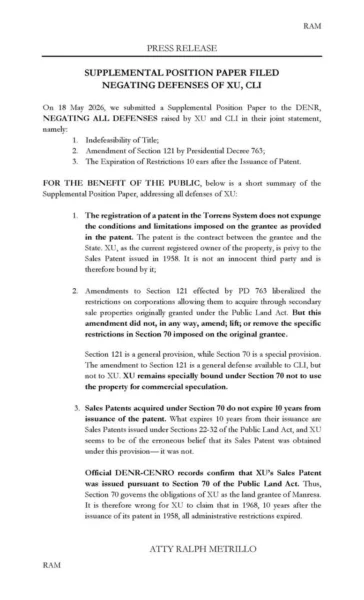
Lawyer Ralph Metrillo filed a supplemental position paper on May 18, directly challenging the core legal defenses raised by XU and its development partner, Cebu Landmasters Inc. (CLI), regarding the sweeping modernization project.
The DENR is scheduled to hear oral arguments this Tuesday as questions persist over whether the prime Manresa land—originally granted by the state specifically for educational and institutional purposes—can legally be converted into a commercial hub.
In a statement sent to this paper on May 24, Metrillo systematically disputed XU and CLI’s assertions regarding the indefeasibility of their land title, the application of Presidential Decree No. 763, and the developers' prominent argument that all property restrictions expired after 10 years.
According to Metrillo, holding a Torrens title does not automatically erase the foundational obligations attached to the original State grant.
“The patent is the contract between the grantee and the State. XU, as the current registered owner of the property, is privy to the Sales Patent issued in 1958. It is not an innocent third party and is therefore bound by it,” Metrillo stated.
The opposition's latest filing further argues that while Presidential Decree No. 763 amended Section 121 of the Public Land Act, it did not repeal or lift the restrictions imposed under Section 70, the specific provision under which the Manresa property was reportedly granted.
“Section 121 is a general provision, while Section 70 is a special provision," the lawyer explained. "The amendment to Section 121 did not amend, lift, or remove the restrictions imposed on the original grantee.”
Metrillo's supplemental paper also took aim at XU’s timeline, disputing the university's claim that all restrictions expired in 1968.
He clarified that the 10-year expiration period applies exclusively to Sales Patents issued under Sections 22 to 32 of the Public Land Act, and has no legal bearing on Section 70 grants.
To back the claim, the filing cited official records from the DENR Community Environment and Natural Resources Office (CENRO), which allegedly confirm that the Manresa property falls squarely under Section 70.
“It is therefore wrong for XU to claim that in 1968, all administrative restrictions expired,” Metrillo said.
Meanwhile, XU and CLI are holding their ground.
In a joint statement, both entities shot back, declaring that the modernization of Jesuit education in Mindanao “will not be delayed by external noise or legally untenable claims.”
The developers maintained that XU has held absolute title over the property for nearly 70 years and that any historical administrative restrictions expired in 1968 under the full protection and guarantees of the Torrens system.
They further emphasized that the master-planned development remains institutional and visionary in its scope.
“We are moving forward with the construction of a legacy. The Manresa campus will be built. The future of Xavier University–Ateneo de Cagayan and Cagayan de Oro is non-negotiable,” their statement concluded.