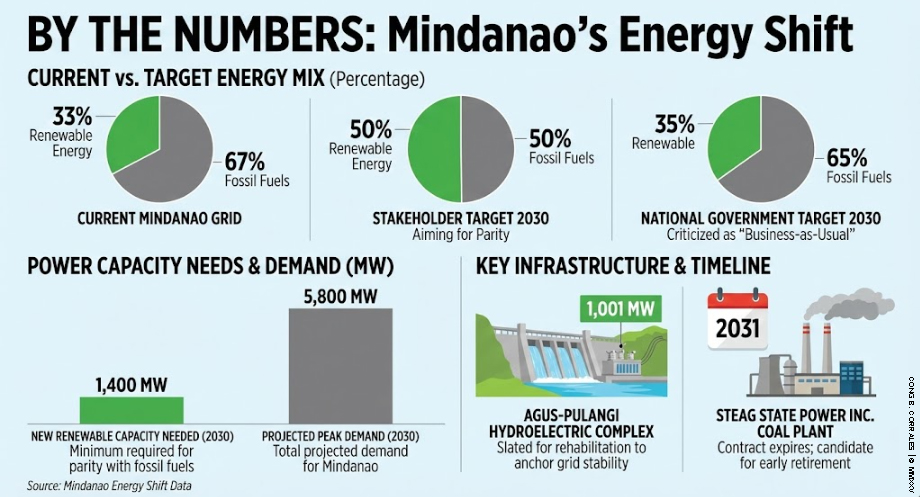
ENERGY stakeholders in Mindanao have agreed to pursue an equal share of renewable and fossil fuel sources in the island’s energy mix by 2030.
The push for a 50-50 ratio surpasses the national government's target of 35-65 set for the same year under the Philippines' Nationally Determined Contribution to the Paris Climate Agreement.
Currently, the Mindanao Grid operates on a mix of 33% renewable energy and 67% fossil fuel.
“Mindanao is aiming to move even faster towards a balanced renewable energy and fossil fuel mix. This move underpins industrialization, job creation, and resilience,” Mindanao Development Authority (MinDA) Secretary Leo Tereso Magno said in a message to the 3rd Mindanao Clean Energy Forum (MCEF) held Nov. 19-20.
“To achieve this, we need to mobilize, to tap billions of pesos of investments,” he added.
Market signals
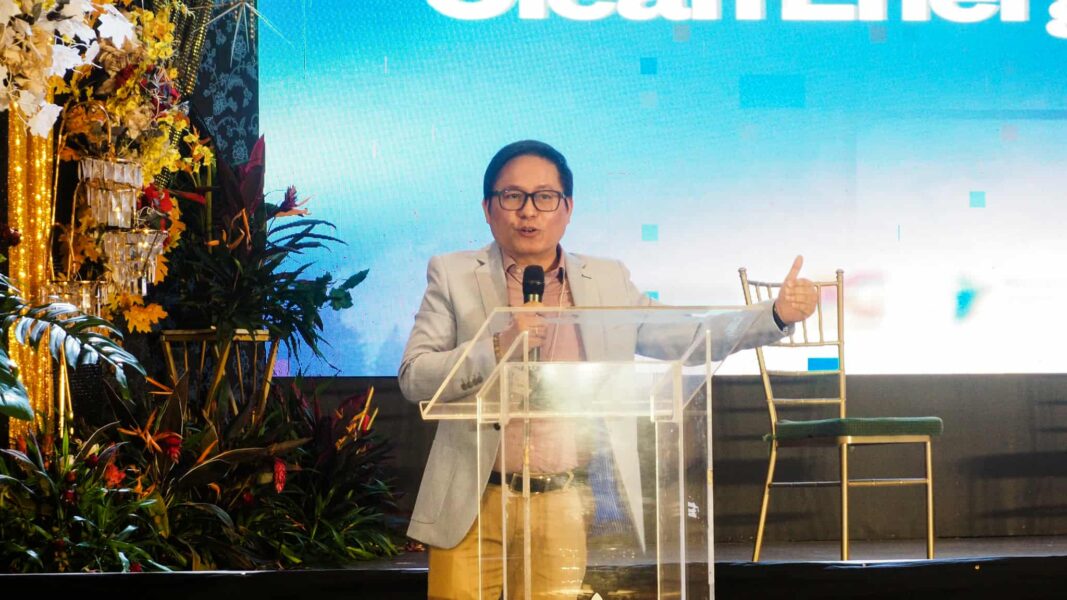
MinDA Deputy Executive Director Assistant Secretary Romeo Montenegro said consumers play a vital role in shifting the market.
“Mindanao power consumers should create the demand for renewable energy. We have to create a mindset, we have to create a demand for renewable energy,” Montenegro said.
He urged the Department of Energy (DOE) to signal that renewables are the future, noting the need to be sensitive to Mindanaoans' desire for clean, affordable, and secure power.
BenCyrus G. Ellorin of the Consumers for Renewable Energy Action in Mindanao (CREAM) criticized the national government's 35-65 target as “business-as-usual” and lacking ambition.
Meanwhile, Agusan del Norte Electric Cooperative (ANECO) General Manager Darwin Daymiel noted that renewable energy prices have become more stable and cheaper than coal, thanks to tax exemptions and incentives. ANECO already sources 56% of its power from renewables.
To reach parity with fossil fuels, the island needs at least 1,400 megawatts (MW) of new renewable capacity by 2030. The projected peak demand for that year is 5,800 MW, against a current installed renewable capacity of about 1,500 MW.
Friction with DOE
Forum participants — representing civil society, business, electric cooperatives, academia, and consumers — called on the DOE to strengthen the moratorium on new coal plants. They specifically asked that the ban cover “brownfield” projects or expansions filed before the moratorium takes full effect in 2030.
Recent remarks by DOE Secretary Sharon Garin relaxing the moratorium drew sharp criticism.
“The declaration of the DOE further waters down the already nebulous coal moratorium. Why is the DOE undermining its own policies?” Ellorin asked.
Participants also expressed regret over the DOE’s absence at the event despite invitations.
Consequently, the forum formally requested the DOE to approve MinDA’s proposal to reconvene the Mindanao Power Monitoring Committee (MPMC). They sought broader representation from non-government sectors to focus on acceleration policies. MinDA and the DOE co-chair the committee, which was established in 2012.
No new coal
Montenegro stressed that achieving the 50-50 target requires a total ban on new coal-fired power plants and the expansion of existing ones.
He also called for the decommissioning of the aging Steag Mindanao Coal-fired Power Plant in Villanueva, Misamis Oriental, noting its Build-Operate-Transfer contract expires in 2031. The plant is a candidate for early retirement under the Asian Development Bank’s Energy Transition Mechanism.
Agus-Pulangi rehabilitation
A crucial component of the transition is the rehabilitation of the 1,001-MW Agus-Pulangi Hydroelectric Complex (APHC), Mindanao’s largest power asset.
Montenegro said the complex would provide grid stability to compensate for the retirement of the 232-MW Steag plant.
Greenergy Development Corp. has submitted an unsolicited proposal for an Energy Storage Project to rehabilitate, operate, and maintain the complex.
The Public-Private Partnership Center is reviewing the proposal. Once cleared, the Power Sector Assets and Liabilities Management Corp. (PSALM) will conduct a technical evaluation and potentially subject it to a Swiss challenge.
PSALM aims to begin the APHC rehabilitation next year.
The 3rd MCEF was organized by MinREACH in partnership with the World Wide Fund for Nature (WWF), the City Government of Butuan, the Institute for Climate and Sustainable Cities, and CREAM.