THE Bud Dajo Massacre in Jolo was carried out under the command of Gen. Leonard Wood, the same figure who later clashed with Filipino nationalist leaders — including Manuel L. Quezon — as they pushed for independence from the United States.
Wood remains a pivotal figure in Philippine history. He served as governor of the Moro Province from 1903 to 1906, when the Bud Dajo massacre occurred, and later as Governor General from 1921 to 1927, a period when Quezon was consolidating his political influence.
Wood is also featured as a central character in the 2025 historical biopic “Quezon,” directed by Jerrold Tarog and starring Jericho Rosales in the title role.
The film focuses on the political rivalries and alliances that shaped Quezon’s rise during the American occupation, depicting his struggle for independence amid a complex colonial bureaucracy and the run-up to the 1935 elections. It serves as the concluding installment of Tarog’s acclaimed “Bayaniverse” trilogy, following “Heneral Luna” (2015) and “Goyo: Ang Batang Heneral” (2018), headlined by John Arcilla and Paulo Avelino, respectively.
At the heart of “Quezon” lies the political tension between Quezon and Wood during the latter’s tenure as Governor General — a defining clash that highlighted two competing visions for the Philippines’ future under American rule.
Wood opposed granting the Philippines immediate independence, arguing the nation was not yet ready. His stance often brought him into conflict with Filipino leaders advocating for self-governance and national dignity.
Wood’s legacy is also inseparable from the Bud Dajo massacre, a tragedy recently revisited in Sari Dalena’s “Cinemartyrs,” one of the official full-length entries at the 2025 Cinemalaya Independent Film Festival.
The 104-minute docudrama draws inspiration from Dalena’s 2001 debut, “Memories of a Forgotten War,” which examined the largely overlooked atrocities of the Philippine-American War.
In “Cinemartyrs,” a young filmmaker (played by Nour Hooshmand) travels to a massacre site in Jolo to shoot a documentary. The film explores themes of memory, war, womanhood, and history while paying homage to female filmmakers in Philippine cinema. As the crew films in war-scarred landscapes, they begin to feel haunted by the spirits of those who perished in the conflict.
The Battle of Bud Dajo was a counterinsurgency campaign led by Wood’s forces against the Moro people in March 1906, during what Americans then called the “Philippine Insurrection.”
As governor and military chief of the Moro Province, Wood imposed strict regulations on the Tausug population — ordering them to surrender their weapons, abandon slavery, register their land, mark their cattle, send their children to school, and pay the cedula tax.
Many Tausugs fled to the mountains under the leadership of seven datus who refused to comply, insisting it was their land and rejecting subjugation to a foreign power.
Wood responded with the command to “Kill or capture those savages!” His troops attacked fortified Moro settlements, including one near the 2,000-foot volcanic crater of Bud Dajo.
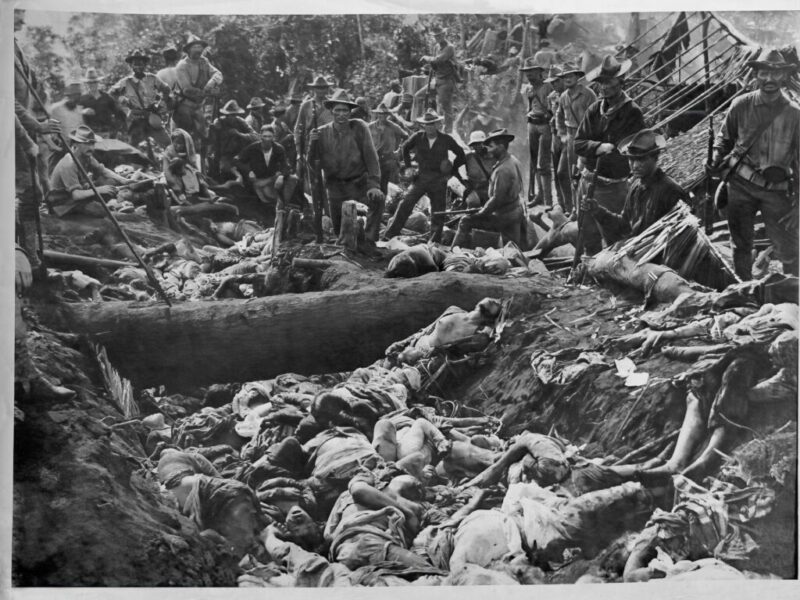
American forces reportedly ambushed a wedding, triggering a three-day battle that ended with the deaths of more than 1,000 Tausugs — including women and children.
A harrowing scene in “Cinemartyrs” recreates the infamous photograph taken on March 8, 1906, by Aeronaut Gibbs, showing American soldiers posing triumphantly over a trench filled with Moro corpses. Among the bodies lies the unmistakable figure of a woman, her head tilted back in agony, her infant swaddled beside her — an image that has come to symbolize the brutality of empire.
The massacre exposed the deep tension between American colonial authority and Filipino aspirations for self-determination — the same struggle that defined Quezon’s political career.
For the Americans, Bud Dajo was labeled a “rebellion.” For the Moros, it was an act of defense — a desperate stand to protect their homeland from foreign intrusion.
Bud Dajo has largely faded from public memory. Yet, as Dalena reminds us, not all histories remain silent. “The genocide is mirroring,” she said. “I want to amplify that the horrors of war are happening again and again and again.”
Dalena received the Best Director Award for what jurors described as “her bold and visionary authorship that fuses cinema, history, and haunting memory into a singular act of resistance — reclaiming women’s voices within the nation’s buried traumas through guerrilla filmmaking that is both mystical and political.”
The film also won the Special Jury Award and Best Musical Scoring. Dalena, a professor of film at the University of the Philippines, continues to challenge the boundaries between art and historical reckoning — giving voice to stories that refuse to stay buried.
(Peyups is the moniker for the University of the Philippines. Atty. Dennis R. Gorecho heads the Seafarers’ Division of the Sapalo Velez Bundang Bulilan Law Offices. For comments, email info@sapalovelez.com or call 0917-502-5808.)