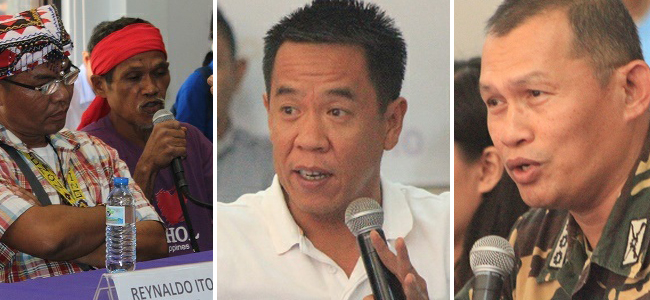

By NITZ ARANCON and GERALD LEIGH LAQUINON Correspondents  EVACUEES who camped out at the capitol grounds are scheduled to return to their villages in Lagonglong, Misamis Oriental despite their failure to make Army officials agree on their demand to leave their communities during a dialogue brokered by Gov. Yevgeny Vicente Emano. The only agreement reached was that the evacuees would return to their homes in sitios Camansi and Tapol in Barangay Banglay, Lagonglong without military escorts. Emano said the evacuees, about 47 families or some 240 indigenes, would be accompanied by a group from the capitol led by Provincial Disaster Risk Reduction Management officer Fernando Dy as they return to their village today. Emano said the evacuees would bring with them seedlings for their farms from the capitol. During the Emano-brokered dialogue at the Capitol Training Center, the tribal group from Lagonglong presented a one-page list of demands that include an agreement that the military would not deploy soldiers to their villages and that it would not build detachments near their houses, schools and farms. The group also demanded that soldiers operating against members of the New People’s Army (NPA) in Lagonglong would only be allowed to pass by their villages, and that villagers should never be accused of being rebels or asked to surrender. The tribal group said soldiers should respect their culture. Iglesia Filipina Independiente priest Fr. Christopher Ablon of the human rights monitor Karapatan said the tribal group has a basis in making the demands, citing a international humanitarian law that provides that soldiers involved in military operations should keep their distance from civilian communities so that innocent people would not get caught in the crossfires. But Army officials were noncommittal. Col. Jessie Alvarez, commander of the 403rd Brigade; Lt. Col. Francis Carangdang, 58th Infantry Battalion commander, and Camp Evangelista spokesman Capt. Joe Patrick Martinez declined to sign any agreement. “Amo usa kining tun-an ug maayo ang inyong gusto kay dili man mahimo nga kami ra ang magboot-boot sa pag-pirma niining inyong gusto kay duna pa man kami  tag-as nga official,” Alvarez said. Alvarez however said the military would look into allegations of abuses against soldiers fielded to the Lagonglong villages. He urged anyone who felt aggrieved to file formal complaints so that the military could investigate and discipline any erring soldier. Jimmy and Richelle Hilogon, evacuees, alleged that in June, soldiers from the 58th Infantry Battalion harassed villagers. Jimmy said he was accused of being an armed rebel. “Wala man koy armas,  nag-uma sa man ko, ang akong armas, guna ra man.” Tribal chieftain Reynaldo Itong alleged that soldiers ransacked his house and took his belongings, including his solar -powered light. “Mas maayo nang mo-file sila ug  formal complaint aron amo kana nga nahatagan ug tukma nga action ug among madisiplina ang among nga sundalo kon tino-od man kanang ilang mga akosasyon,” he said. Alvarez said the soldiers in Lagonglong were sent there to help in the government’s peace and development efforts. He said soldiers were sent there for pakighigala (rapport). IFI Bishop Felixberto Calang, who attended the dialogue, snapped: “Mas maayo nga pakighigala ang toyo sa mga sundalo pero sa rason nga daghan ang mibakwit gikan sa Sitio Camansi, basin na-ay deperensiya ang  ilang pakighigala.” A day earlier, the Commission on Human Rights (CHR) and the National Commission of Indigenous People (NCIP) would start their own investigations into the complaints of evacuees about alleged “military violations” in the villages of Lagonglong town. The investigations were promised after the evacuees trooped to the CHR and NHIP regional offices on Wednesday to air their grievances. They demanded that the CHR and NHIP acted on their complaints. “We will conduct necessary investigation on this matter since their concerns are valid,” said Rey Cahis, a CHR senior special investigator. He said an investigation report would follow, and would be the basis for legal actions. The CHR, Cahis said, may ask appropriate government agencies to file the cases. Asked if the evacuees have the right to insist for a written agreement with the 58th Infantry Battalion, Cahis said, “The evacuees must be ensured against harassment and disturbance of their peaceful dwelling, but the military must also be heard.” Jomorito Goaynon, secretary general of Kalumbay-Lumad Organization in northern Mindanao, said they were thankful for the promise. “It is a welcome development that they vowed to investigate military violations like the encampment at a school in Camansi, and their basing in community centers, as well as their coercions on lumads to surrender,” said Goaynon. Goaynon also welcomed the promise of the NCIP to bring the matter to the Regional Peace and Order Council on Monday. The Council is chaired by Cagayan de Oro Mayor Oscar Moreno. The office, he said, also promised an independent investigation to help the evacuees, and to facilitate dialogues. Goaynon, however, criticized the provincial office of NCIP whose personnel “just received our complaint letter and who admitted that they don’t know there are evacuees although their office is just steps away from the capitol grounds where the lumads took retreat.” Goaynon also expressed dismay after Cahis admitted that the CHR did not know that there were evacuees. “It is questionable. This is the fourth evacuation from these communities due to militarization, and the second for them to encamp at the capitol grounds, but the CHR doesn’t know at all,” said Goaynon.