AMID swirling allegations of corruption plaguing government flood control projects in the Philippines, European Union envoys have drawn a line in the sand: their funding remains untouched by anomalies.
During a recent visit to Northern Mindanao, top European diplomats acknowledged the ongoing public outcry regarding local infrastructure projects but assured the public that EU-funded grants operate under a different, more rigorous set of rules.
French Ambassador to the Philippines Marie Fontanel said the EU remains confident that its development assistance is shielded by strict regulations and established governance frameworks.
“As development assistance is concerned, the EU abides by its own rules,” Fontanel said, emphasizing that they enforce specific compliance mechanisms and accountability standards for partner governments.
However, Fontanel noted that the EU is ready to share its expertise to help the country combat graft, stressing that systemic changes are necessary.
“We know it is impossible to change the way things are done and we know that strict legislation can help prevent these kinds of situations,” she said.
She cited the lifting of bank secrecy as a prime example of how stronger legislation could force transparency.
“There is no magical button to fight corruption,” she emphasized.
European Union Ambassador to the Philippines Massimo Santoro backed this sentiment, expressing full confidence in the integrity of ongoing EU projects in the country.
“There are no worries from our side. All grants funded by the European Union follow very precise processes and undergo rigorous scrutiny,” Santoro said. “We have specific modalities, and we find no space for any anomalies or corruption.”
Santoro stressed that the bloc has not recorded a single instance where its funds in the Philippines were misused or linked to corrupt officials.
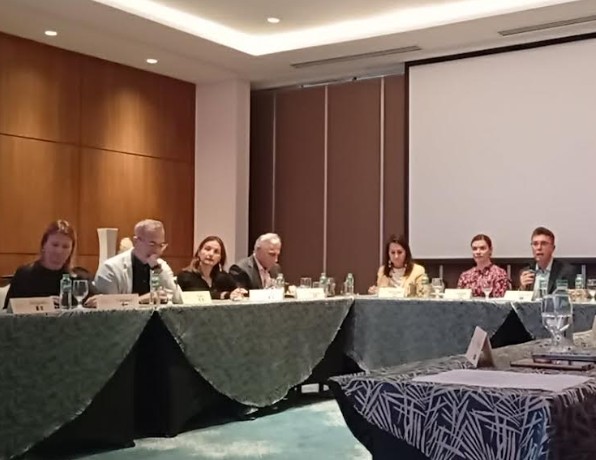
The envoys were part of a delegation of 17 EU ambassadors visiting Cagayan de Oro City, Misamis Oriental, and Bukidnon. Beyond addressing governance issues, the EU reiterated its commitment to supporting indigenous peoples, renewable energy, and sustainable development in the region.