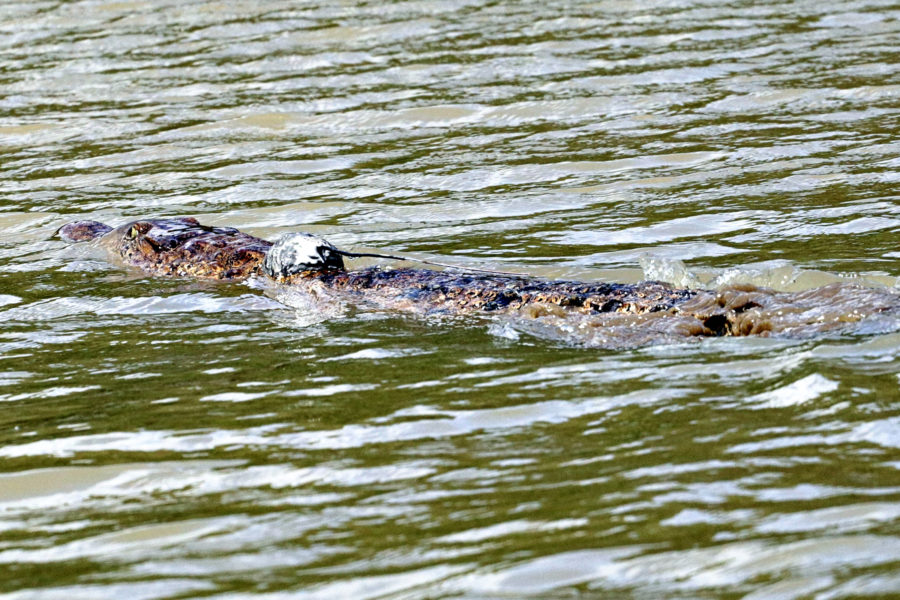
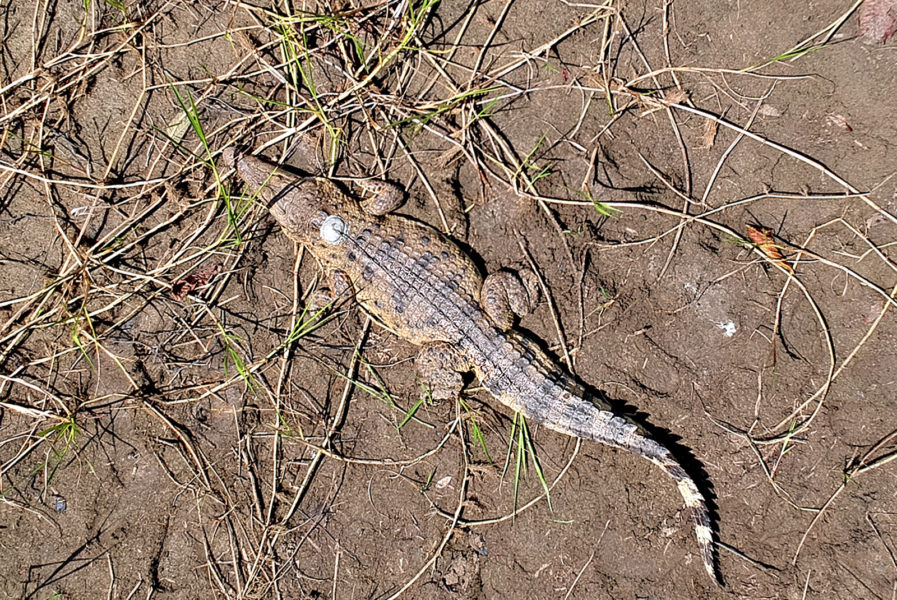
 TRANSMITTING CROC. A six-foot-long adult Philippine Crocodile (Crocodylus mindorensis) with a radio transmitter on its back along the banks of the Paghungawan Marsh in Pilar town, Siargao Island. Photo by Erwin M. Mascariñas
New crocodile stock from Germany
On December 15, after nine months of delay due to the global pandemic, two offspring of the loaned Philippine crocodile arrived in Manila from Germany. Named Hulky and Dodong, the crocodiles are the first out of the 12 that will be coming to the Philippines after a successful breeding program in Cologne Zoo, Germany. After acclimation, the juveniles will build up a pure colony in the Philippines for subsequent reintroduction into the wild. The first Philippine crocodile captive breeding program in Europe was officially initiated in April 2012, when the European Studbook (ESB) was established by the European Association of Zoos and Aquaria (EAZA), administered by Cologne Zoo, Germany. The goal of the ESB was to build up a captive assurance reserve colony in Europe for the Critically Endangered Philippine Crocodile. “This is an excellent and positive example of how ex-situ measures such as conservation breeding projects, coordinated by modern, scientifically led zoos, can help to actively support the in-situ conservation measures in the country of origin,” says Prof. Dr. Thomas Ziegler, who also is the Regional Chairman for Europe of the IUCN Crocodile Specialist Group. Cologne Zoo’s director Professor Theo B. Pagel, president of the World Association of Zoos and Aquariums (WAZA) noted that the program is another successful example of the “One Plan Approach” which is supported by the IUCN and aims to develop integrative strategies to combine in-situ and ex-situ measures with groups of experts for species conservation. The Department of Environment and Natural Resources - Biodiversity Management Bureau (DENR-BMB) in collaboration with the CPPI has plans for further repatriation of offspring from the European Captive-breeding program to the Philippines. Manalo who also is Regional Vice Chairman (Philippines) for East and Southeast Asia of the IUCN Crocodile Specialist Group pointed out that there are sufficient space and suitable habitat in the South for restocking Philippine crocodiles.New crocodile population
On December 10, 2019, the CPPI team stumbled on the crocodile population after they investigated parts of the Maladi and Miundas River and the connecting river system in the town of Malabang. “After 4 decades of being obscured to science, a new population of Philippine crocodile has been revealed, finally we’ve recorded the first known population of the species in varying life stages, hatchling, juvenile, sub-adult and adults in the major rivers of Malabang, Lanao del Sur Province, Bangsamoro Autonomous Region of Muslim Mindanao,” said Manalo. PCCI report indicated that the crocodiles were thriving and contain a healthy viable population that remains unharmed because of the cultural protection of the indigenous Muslim community in this region and that most outsiders have considered the province as a conflict area. “It was something new for us; that part of Mindanao has never been in any records for sightings of the Philippine Crocodile. Even with our short stay in the area, we found what we can consider as a healthy population of the species. This is something worth celebrating as the species has been in decline and considered as critically endangered with less than 200 recorded populations in the wild,” said Manalo. Manalo estimates that there are at least 20 crocodiles in Malabang and with additional research, there could be more in the adjacent river deltas towards the mountain areas of Lanao del Sur and believes to have more than a hundred if the entire area will be properly investigated. Since 2017, PCCI has had several reports that there might be small pockets of the population of the said crocodile but we never had the chance to investigate it further in the ground. The recent discovery will open up new possibilities and research for the conservation of the species. Initial plans for further population survey in Malabang town in Lanao del Sur in 2020 was halted by the pandemic’s lockdown. “Hopefully, we will be able to return to Lanao del Sur in 2021 to follow-up on our 2019 find and conduct a further research study,” said Manalo.