By Ivy Marie A. Mangadlao
Correspondent
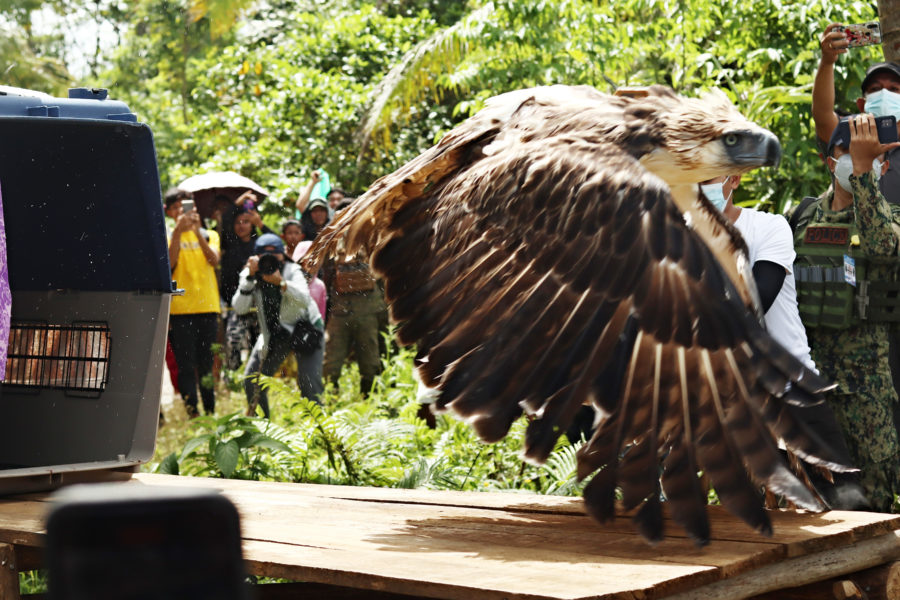
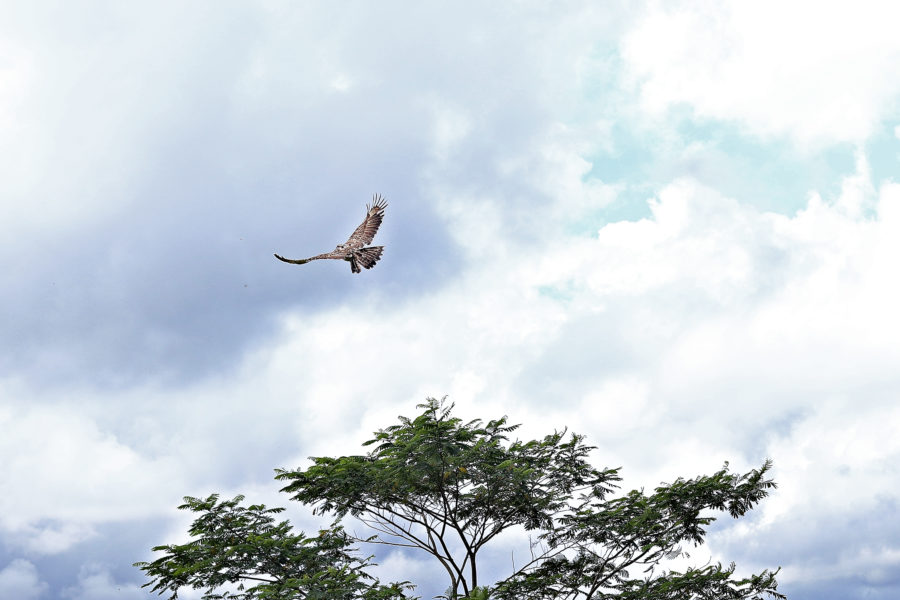
BISLIG CITY, Surigao del Sur ― Eagle conservationists and government agencies released a rescued critically endangered Philippine eagle back to its home forest last Wednesday after it spent more than seven months at the Philippine Eagle Center (PEC) in Davao City for its rehabilitation.
The release was done on a roadside near the forest in Lingig town in Surigao del Sur province where the eagle was rescued last March 23 by three concerned citizens namely Jerry Cotic, barangay councilor, and couple Reynalyn Gay-od and Richard Mahumoc, both indigenous Manobo Simuwawnon residents of Barangay Rajah Cabungsuan.
The raptor, estimated to be five years old, was named Rajah Cabungsuan to honor the place where it was found.
The rescuers bought the raptor for P5,000 from the hunters who caught it using an animal trap intended for monitor lizards.
“After I heard that it was a Philippine eagle they’ve caught, I didn’t exactly know what to do. I just believed that something must be done,” Mahumoc said.
Rescuers turned over the Philippine eagle to the Department of Environment and Natural Resources (DENR) Caraga and were further treated and rehabilitated at PEC in Davao City.
Dr. Bayani Vandenbroek, on-call veterinarian of PEF said that during the examination, the x-ray showed neither bone fractures nor bullets or projectiles inside its body.
Jayson Ibañez, Director for Research and Conservation of Philippine Eagle Foundation said that the release of Rajah Cabungsuan is considered a charismatic event and an alarm call to the public.
“Releases are very charismatic events, as you can see what we are trying to do here is to use eagle releases as a platform for awareness and conservation education highlighting first the issue of human persecution that still exists and perhaps the single most important threat to the Philippines Eagle survival,” Ibañez said.
PEF revealed that the primary objective of the release is to re-integrate Philippine eagle “Rajah Cabungsuan” into the wild population.
“At its age of over five years old, he might have a mate already. Releasing him no later than November 2021 would increase his chances of reuniting with its pair and the pair nesting. Because a GPS tracker will be attached to the eagle, we will be able to monitor this very exciting and previously undocumented aspect of the eagle’s pairing behavior,” PEF stated.
Rajah Cabungsuan is the second Philippine eagle rescued in the Caraga region since the onset of the pandemic after Balikatan was rescued in the town of Bacuag in Surigao del Norte last August 2020.
The bird was under the care of Ryan Orquina, who had bought the eagle from an Indigenous Mamanwa trapper for P8,000.
The raptor was brought to the PEC for rehabilitation.
After a health checkup, they found that Balikatan completely lost his vision in the left eye while his right eye was showing early signs of cataracts. As a result of the examination, PEC announced that the eagle will not be able to fly back to its home as an eagle needs its keen eyesight and its sharp talons to hunt in the forest.
“The situation in Caraga is very alarming as there are still some Filipinos who consider Philippine eagles as an item of trade revealing the perspective that some don't see the significance of the country's national bird,” Ibañez said.
Ibañez pointed out that making the Philippine eagle an ambassador of other wildlife will help to protect the entire ecosystem.
“If we're able to change attitudes and then convince local government units and ancestral domain owners to protect the 7,000 hectares of forest for the Philippine eagle pair, that will also protect the rest of the wildlife within that 7,000 hectares area. You used that charisma and the participation in Philippine eagle conservation as an entry point to popularizing conservation of the less charismatic animals,” Ibañez said.
He added that the power of having the Philippine eagle as a flagship for wildlife protection will not only conserve the country’s national bird but conserve the rest of the flora and fauna.