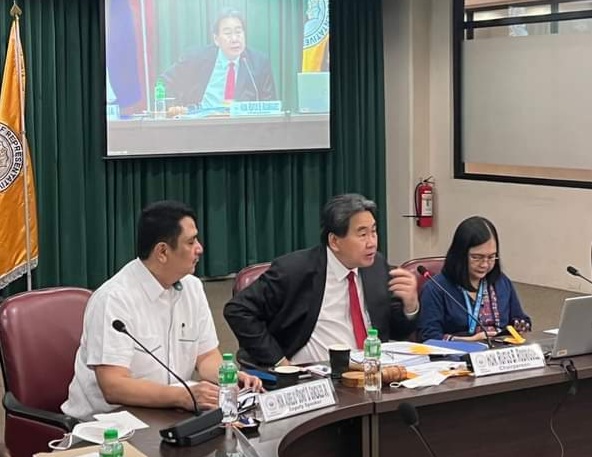
SOME local officials in Cagayan de Oro City earlier agreed in a House hearing that it is high time for a legislative measure to lift the “restrictive” economic provisions of the Constitution, but for others, the country is just not ready for another “Cha-cha” (Charter change).
For the first time since the pandemic, the discussion on Charter Change (Cha-cha) once again took the spotlight as the House Committee on Constitutional Amendments chaired by Cagayan de Oro Rep. Rufus Rodriguez who conducted a hearing and consultation, late last week.
“It’s about time, for some requirements, especially economic provisions,” said Councilor Jose Pepe Abbu, assistant minority floor leader of the City Council.
Abbu said that Cha-cha can also be a solution, however, it (Cha-cha) is a long process that can never settle an immediate economic solution for the city to recover economically.
“It needs the creation of Constitutional Assembly or Convention, tapos deliberation pa sa proposed provisions for amendment then approval and ratification pa,” said Abbu adding that it can have a long-lasting application because it’s a law.
Like Abbu, Councilor Imee Moreno, chair of the City Council’s committee on women and family relations said room for Cha-cha is always there especially when the structure can no longer respond to the pressing needs.
But according to her, legislatures have to be careful in doing so because they are changing the highest law of the land.
"The legislatures have to make sure that laws are not put in place that will only support the few but laws that are for the welfare of the majority," said Moreno.
“Having an economic Cha-cha would be in place, to further address the changing needs,” she said.
However, Moreno added the act of doing the Cha-cha would be very delicate and very time-consuming and there are so many pressing issues that need to be addressed.
"I still would agree to do other options to be able to satisfy the current economic problems the country is up against,” she said.
Moreno’s party-mate Majority Floor leader Councilor Ian Mark Nacaya preferred more economic reforms and stimulus that will boost the business communities than Cha-cha.
“Not now. Let's prioritize the conduct of our public affairs,” said Nacaya.
Abbu agreed with Nacaya that creating an aggressive fiscal stimulus is more immediate but still needs further study and it may vary who is in the administration.
A retired Army and currently Barangay Patag councilor Efren Penaflor said Cha-cha as a political exercise deserves objective consideration.
“Samtang ang 1987 Constitution nakaalagad og maayo sa nasud, kini layo sa hingpit. Sa pagsugod, adunay daghang mga kontrobersyal nga mga provisions sa Konstitusyon,” said Penaflor.
Penaflor said the former president Duterte is even keen on abolishing or amending the party list system to eliminate the communist insurgency.
“Pres. Duterte is believing that the Communist Party of the Philippines and the New People’s Army have abused the party list system,” said Pensflor
It cannot be denied that since its inception, the party list system has been used by many as a shortcut to Congress, according to Penaflor.
Meanwhile, the earlier House committee hearing, chaired by Rep. Rodriguez, has invited esteemed panel members who debated on legal, political, and socio-economic nuisances of the proposals.
Among was the R.B.H. 2 – “Resolution of Both Houses Proposing Amendments to Certain Economic Provisions of the 1987 Constitution of the Republic of the Philippines Particularly on Article XII, XIV & XVI”, authored by Rep. Lord Allan Q. Velasco;
"Our country is not only ready but needs Cha cha, especially on economic provisions in our Constitution to open our country for more foreign investments and give more employment to our people," said Rodriguez.
Rodriguez even said no amount of aggressive fiscal stimulus will bring it foreign investments because of the very restrictive provisions in our Constitution.
A former law dean, Rodriguez said the rationale of the whole proceeding is “to get the sense and pulse of the people on the important issue of Constitutional reform and how it affects their lives.”
Rodriguez likewise said that the committee will publish its findings and determine the need for more consultative hearings, especially at the grassroots level.
There are currently 8 legislative measures that seek to propose amendments to the 36-year-old Constitution of the Philippines.
Present during the hearing were Justice Vicente V. Mendoza (Ret.), Justice Adolfo S. Azcuna (Ret.),and Atty. Raul L. Lambino (Member 2005 Con-Com), Dr. Raul V. Fabella (UP-Econ), Dr. Gerardo P. Sicat (UP-Econ), Dr. Solita Collas-Monsod, (UP-Econ), former finance Sec. Margarito B. Teves, among others.
During the hearing, the resource persons provided their expert opinions, albeit divided to some extent, on whether there is a need to amend or revise the Constitution; and if now is the right time to do so — a recurring question ever since the talks on Cha-cha persisted.
Christian Monsod, a former Commission on Elections Chairman and one of the framers of the 1987 Constitution, asserted that the present charter is the solution to the country's problems if only it is fully implemented.
He also noted that the current legislative agenda of President Ferdinand Marcos Jr. does not include rewriting the Constitution.
Meanwhile, Atty. Neri Javier Colmenares of the National Union of People’s Lawyers said that “there is no need for cha-cha today because the problems of poverty, corruption, social justice lahat yan [all that] did not come from the Constitution."
Despite qualms on timing and socio-economic impacts, lawyer Dionisio Donato Garciano of Philconsa stated, “we must give this committee the benefit of the doubt in proposing amendments to the 1987 Constitution. This initiative is made with good intentions.”
![Graphic showing a gold 2026 Gawad Kalasag award shield next to text announcing Cagayan de Oro City as a Gold Recognition winner in the Highly Urbanized City Category for Northern Mindanao. The graphic includes official city seals and information on DRRM compliance under RA 10121[cite: 13].](https://uploads.mindanaogoldstardaily.com/2026/09/cagayan-de-oro-gawad-kalasag-2026-gold-award-highly-urbanized-city-medium-696x392.webp)