ILIGAN City — The money that once bought ₱100 worth of goods in 2018 now buys only about ₱74 worth, leaving consumers in Iligan City and Lanao del Norte with less purchasing power as prices continue to rise.
The Philippine Statistics Authority (PSA) reported that the peso's purchasing power fell to 0.74 in October 2026, equivalent to a 26-percent decline from its 2018 base-year value.
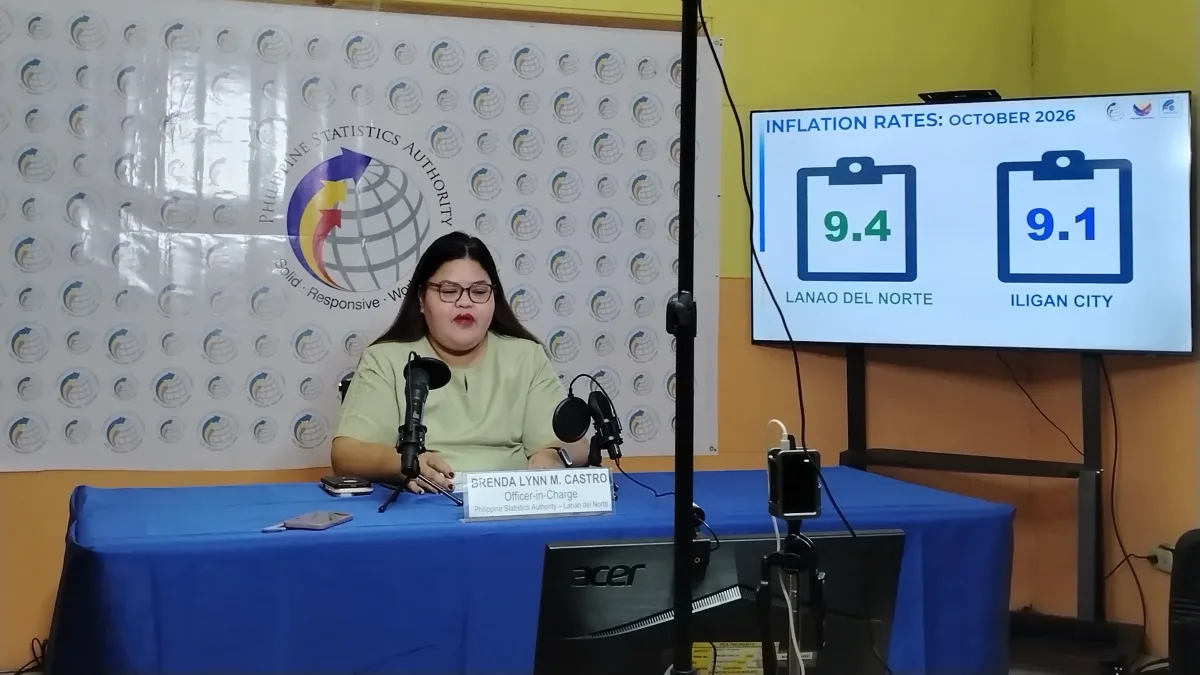
Brenda Lynn M. Castro, officer-in-charge of the PSA-Lanao del Norte Provincial Statistical Office, said the decline reflects the continuing increase in commodity prices.
The latest figures also showed inflation accelerating in both areas. Lanao del Norte's inflation rate rose to 9.4 percent in October from 8.7 percent in September, while Iligan City recorded 9.1 percent, up from 8.5 percent.
From January to October, average inflation reached 7.2 percent in Iligan City and 6.9 percent in Lanao del Norte.
Fuel costs drive inflation
Transportation was the biggest contributor to the acceleration of inflation in both areas, largely due to higher fuel prices, particularly gasoline.
In Lanao del Norte, transportation inflation jumped to 31.3 percent from 25.2 percent, accounting for 53.2 percent of the overall increase in inflation. Food and non-alcoholic beverages contributed another 37.1 percent.
In Iligan City, transportation accounted for 65.7 percent of the inflation uptrend, with its inflation rate rising to 25 percent from 20.8 percent. Food and non-alcoholic beverages contributed 24.4 percent.
However, the biggest contributors to overall inflation differed between the two areas. Food and non-alcoholic beverages accounted for 42.1 percent in Lanao del Norte, while housing, water, electricity, gas and other fuels made up 42.5 percent in Iligan City.
Poorer households feel the pressure
The impact was also evident among lower-income families, with inflation for households in the bottom 30 percent income group reaching 8.5 percent in Lanao del Norte and 9.1 percent in Iligan City.
Castro explained that the classification covers households ranked within the lowest 30 percent based on income, rather than those earning below a fixed income threshold.
For these households, rice was the biggest contributor to inflation in Lanao del Norte. In Iligan City, gasoline topped the list, followed by rice and rentals.
Wages versus rising prices
During a media briefing, Castro was asked what measures the PSA could recommend to local governments and consumers to ease the impact of rising prices.
She clarified that the agency's role is to monitor price movements and provide statistical data, not prescribe specific interventions.
“Actually, as PSA, we are not in the position to do recommendations on how to cushion the impact, because our mandate is just to monitor the price movement,” she said.
The agency presents its inflation data to the Price Coordinating Council, which uses the figures as a basis for discussions and possible government interventions. The data are also considered by the Regional Tripartite Wages and Productivity Board in reviewing wage rates.
Castro also raised the question of whether workers' earnings are keeping pace with rising prices.
“Imagine ang palaliton nag-increase by this much. Atong mga sweldo nag-increase ba?” she said.
She urged media practitioners to help inform the public about inflation and price movements affecting their communities.
With inflation rising in both areas, the October figures show how higher costs of food, fuel, transportation and housing continue to eat into household budgets.