JEAN, Lourdes, and Hafida come from different battlegrounds.
Two spent years in the mountains adhering to the strict discipline of the New People’s Army (NPA); the other carries the surname of the man who led the siege that brought a city to its knees.
Yet, sitting together recently, their stories converged on a single, shared reality: the war doesn’t end when the shooting stops.
Jean Bautista-Mabaga, a former NPA combatant in the Caraga Region, has traded her rifle for a ladle, making a living selling kakanin (rice cakes) and running an online shop.

But the transition to civilian life hasn’t shielded her from judgment.
“Kahit anong sabihin nila, ang naranasan ko ay di nila mararanasan,” Bautista-Mabaga said.
Instead of letting the discrimination break her, she uses it as fuel, reversing the negativity into a drive to succeed.
It is a sentiment she shares with the other women in the room.
“Galing din ako sa pakikibaka. Nakita ko na pare-pareho ang mga layunin, magkaiba lang ang paraan,” she added, noting the common thread among former women combatants at the WeCare Women Summit, held Thursday, Dec. 11.
Beyond the label
For Lourdes Acenas Caculba, a former NPA combatant from Salay town, the new enemy is social exclusion.
Her battle cry has shifted from armed struggle to a fight for dignity.
“Laban lang sa discrimination,” Caculba said. She emphasized the need for mental clarity and pragmatic solutions to daily hurdles: “Makapagawas og maayong panghuna-huna. Unsa’y solbad sa problema nga giatubang.

”Despite the stigma, Caculba refuses to hide her past, drawing strength from the Maoist code of conduct — the Three Main Rules of Discipline and Eight Points of Attention.
“Proud ko sa unsa’y akong naagian. Nakita nako unsa ang praktika sa tulo ka lagda ug walo ka tahas,” she said.
The weight of a name
Perhaps no one understands the burden of a label quite like Hafida Romato Maute, sister of Omar Maute, co-founder of the Dawlah Islamiyah group that led the 2017 Marawi Siege.
Today, Hafida is a solo parent of three, surviving through online selling.

But her brother’s actions cast a long shadow; discrimination forced her to stop using her surname to protect her children.
Now, she’s reclaiming her narrative. “I use my experience to tell stories of resilience going towards peace,” Hafida said, offering a simple yet powerful message: “Just believe in yourself.”
‘With us, not merely for us’
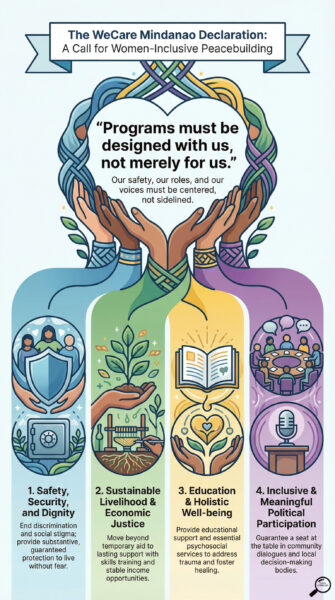
The stories of Jean, Lourdes, and Hafida fueled the “WeCare Mindanao Declaration: A Call for Women-Sensitive Peacebuilding Reintegration.”
Unveiled by the WeCare Mindanao Network — a coalition including the Pananad’m MILF Women’s Council and MNLF Mga Bae Ko Kasalimbago — the manifesto declares their civilian transition “incomplete.”Mida, a representative, pointed out that rehabilitation programs miss the mark without women’s input.“
Programs must be designed with us, not merely for us,” the declaration reads. “We share hopes, but our stories differ.”
Four non-negotiable pillars for genuine peace
1. Safety, Security, and Dignity: End “social stigmatization”; promised protections feel “merely rhetorical”.
2. Sustainable Livelihood: Stable income opportunities, not temporary aid, for economic independence.
3. Holistic Well-being: Scholarships and psychosocial services to address trauma.4. Political Participation: A seat at local decision-making tables.
A warning and a vow
The declaration warns against external interference in the Moro Islamic Liberation Front (MILF)’s evolving status, risking “disillusionment, renewed frustration, and aggression.”
Their message: “No label limits human capacity to transform.”
“We carry war scars, but greater hope for peace,” it concludes. “Partner with us. Honor our dignity. Invest in our vision.”