AS Filipinos begin decorating for the holidays, environmental group BAN Toxics has issued a warning about dangerous levels of lead found in Christmas lights sold in the country.
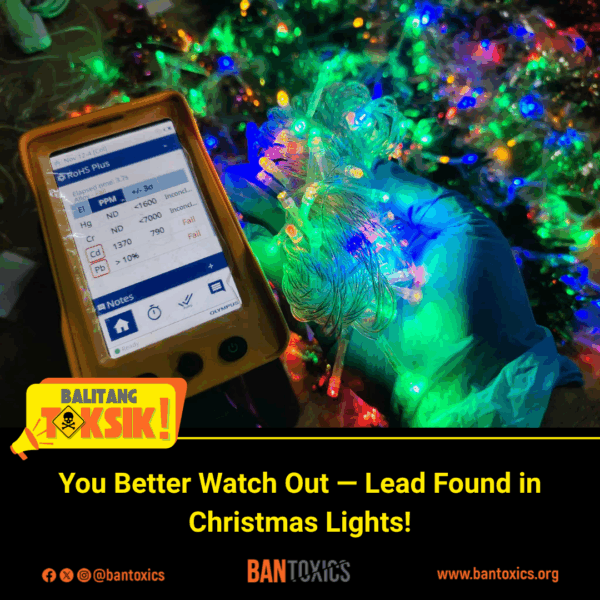
In a recent market check, BAN Toxics purchased six sets of multi-colored Christmas lights priced at P100 each. None of the samples displayed the required Import Commodity Clearance (ICC) sticker that certifies product safety.
Using a Vanta C-Series XRF Analyzer, the group found toxic lead concentrations up to 100,000 parts per million (ppm) in the soldered LED bulbs, the PVC wiring, and circuit boards — far exceeding international safety limits.
Lead exposure poses serious health risks, especially for children who absorb four to five times more lead than adults, according to the World Health Organization. Children’s frequent hand-to-mouth behaviors increase the danger of ingesting lead dust or particles.
Thony Dizon, advocacy officer for BAN Toxics, said lead exposure can cause permanent brain damage, developmental delays, organ damage, lower IQ, and, in severe cases, death.
Handling lead-contaminated wires can leave residues on skin, and outdoor lights exposed to heat and sunlight may release lead dust as the plastic insulation degrades. Improper disposal of these products may contaminate soil, water, and air, raising health risks in communities nearby, the group said.
While Philippine regulations do not currently limit lead content in electrical products, BAN Toxics pointed to the European Union’s Restriction of Hazardous Substances (RoHS) Directive, which caps lead at 1,000 ppm in any component.
The group urged the Department of Trade and Industry to increase market inspections, enforce product safety standards, and consider adopting rules similar to the EU’s RoHS to protect Filipino consumers.
Dizon emphasized the importance of safety labels and markings so buyers can avoid toxic products. “Without proper certification, consumers risk exposure to hazardous chemicals like lead,” he said.