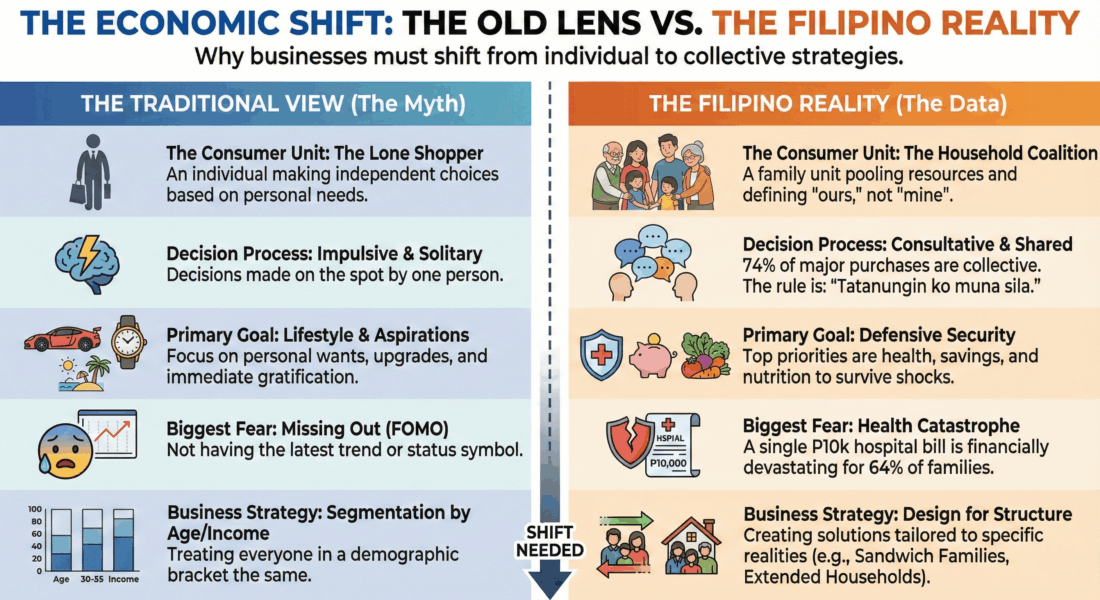
STOP selling to individuals. In the Philippines, the wallet belongs to the family.
For decades, market analysts have treated the Filipino consumer as a solitary figure, crafting strategies around individual impulses. But new research from the Boston Consulting Group (BCG) suggests this approach fundamentally misses the reality of the local economy: the consumer is not a person, but a "household coalition."
A comprehensive study, "The Filipino Family," reveals that in a country where only 9% of households consist of a single person — a sharp contrast to developed nations where single-person homes range from 30% to 45% — the family operates as the primary decision-making unit.
According to BCG findings, 74% of Filipino families make major purchases collectively. This reality necessitates an overhaul of how businesses and policymakers engage the market, shifting toward a "Household-Centric Model" that views shared priorities as the key to economic strategy.
The collective economy
In the Filipino home, resources are pooled and priorities are defined jointly, replacing "mine" with "ours."
This mindset is best summarized by the ubiquitous phrase heard before any major choice: “Mangutana usa ko nila.” (Let me ask them first). Researchers note this consultation is more than a habit; it is an expression of care.
Decision-making is collaborative across essentials:
Groceries: Typically decided with input from multiple members.
Financial Roles: Women commonly manage savings and daily spending, while men tend to lead on financing and long-term investments.
Major Purchases: Decisions on appliances or gadgets are rarely impulsive. Nearly half are discussed at home to weigh financial trade-offs before any action is taken.
The study also underscores the enduring presence of Overseas Filipino Workers (OFWs). Despite geographic separation, more than half of OFWs remain active participants in key decisions, often contributing between one-third and three-fourths of the total household income.
The core vulnerability: health shocks
The aspirations of the household coalition are overwhelmingly defensive. The biggest threat facing Filipino families is not inflation or job loss, but a health catastrophe.
The top three priorities center on security:
Health Security (70%): Being financially prepared to absorb health scares.
Savings (68%): Building a safety fund.
Nutrition (64%): Improving food quality.
This fear is grounded in harsh reality: a staggering 64% of Filipino families cannot cover a modest P10,000 hospital bill without borrowing money.
This looming threat forces families to deprioritize "out-of-reach" aspirations (Napasagdan), such as dream homes or travel. Instead, the focus remains on managing necessities (Gina-asikaso), such as debt payment and basic healthcare.
Six structures, six realities
The report argues that businesses must move beyond segmentation based on income or age. Instead, they should focus on six primary household structures, which encompass about 93% of the population:
Dual-Earner Nuclear Families (23%): Both partners work, often splitting responsibilities via toka-toka, with continuously negotiated roles.
Extended Families (21%): Multi-generational homes where decision-making is distributed, creating complex constraints on savings.
Single-Earner Nuclear Families (20%): One breadwinner shoulders financial responsibility, creating clear but stressful divisions of labor.
Solo Parent Families (14%): One parent manages earning and caregiving, making time the most scarce resource.
Sandwich Families (11%): The middle generation cares for children and aging parents simultaneously.
Dual Income, No Kids (DINK) (4%): Couples focusing on building stability before major commitments.
"A product that works perfectly for DINKs falls flat for a sandwich family juggling three generations. Yet most businesses treat all 'consumers' the same way," said Julian Cua, BCG Managing Director and Partner.
A call for ‘family value propositions’
The findings present a challenge to institutions: stop forcing Filipinos to pretend they are individuals.
To align with this reality, the report urges a strategic shift. Health solutions must move beyond individual HMO plans to offer genuine household coverage. Financial products must recognize that for 64% of MSME owners, the business is not a corporate ladder, but a tool for family independence.
In essence, the family serves as the country’s fundamental safety net. Ignoring the collective unit means missing the core dynamic driving the Philippine economy.