THEY are the calves of the city — knotted, leathered, and perpetually in motion. In the narrow arteries of Cagayan de Oro, where jeepneys cannot fit, the trisikad driver trades sweat for coins. He pushes the weight of the barangay forward, one creaky pedal stroke at a time.
His labored breathing locks into rhythm with the syncopated creak of the chain. Every few meters, his heel strikes the brake — thud — forcing a blast of air through an improvised horn to warn the SUVs claiming Abellanosa Street. He weaves away from the shadows of the UCCP church, banking right to dodge a sedan. We leave the main road for Vega Street, plunging into Isla Cupa.
Here, the intimacy begins. An old election tarp flaps against your spine. The driver shouts a greeting to a colleague passing in the opposite direction — a flash of red, white, and blue umbrella navigating the district’s concrete capillaries. But out here on the asphalt, there is no romance in the ride. For the driver, every rotation of the pedal is a calculation of survival against a city racing toward a future that has no room for him.
The debt machine
To the average commuter, the trisikad is merely a convenience. But for Lourderico “Rico” Pedimonte, 45, the bike is a debt machine. Before he earns a single peso for his family, he must cover the “boundary” — the daily rental fee paid to the unit owner. It is a mathematical poverty trap.
“I wake up at 4 am and my first thought isn’t coffee, it’s the boundary fee,” says Rico, a driver from Barangay Lapasan who has pedaled for two decades. “Every ten-peso coin counts. If I don’t earn that rental fee by noon, my family doesn’t eat dinner. It’s a race where the finish line keeps moving away from us.”
The shrinking cage
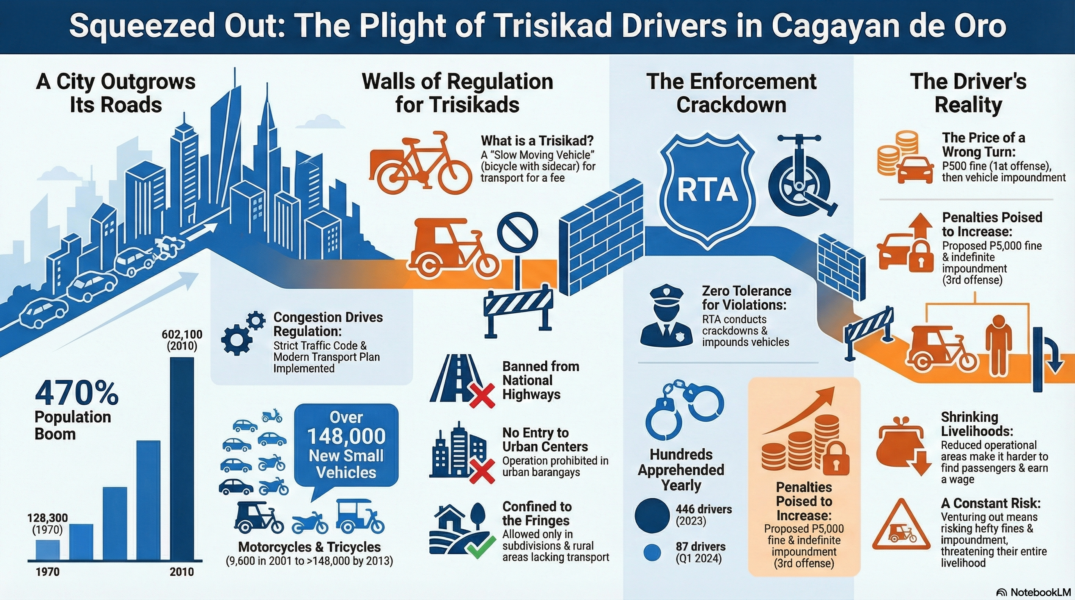
The race has hurdles, and they are man-made. As Cagayan de Oro polices its image of “urban order,” the trisikad has become a visual nuisance to be scrubbed from the main roads. Ramil Lawas, 51, of Barangay Consolacion, operates in a shrinking cage.
Local ordinances have drawn invisible lines across the national highways—boundaries that turn a hardworking father into a criminal the moment his wheel crosses the paint. The threat is constant. It isn’t just a ticket; it is an economic death sentence.
The math of fear
For Ferdielito “Nong Lito” Sinag, the asphalt on J.R. Borja Extension does not just radiate heat; it exhales it. The heat is a physical weight, heavier than the two college students squeezed into his sidecar. His calves tighten into knots of wire and vein. The chain creates a rhythmic, dry crick-crick-crick—a reminder that he needs oil, which costs money he doesn’t have.
In this city, the sikad is the king of the interior alleyway but a fugitive on the main road. Lito earns roughly twenty pesos per short trip. If caught plying a prohibited route, the penalty is P1,500. To a city councilor, that is a lunch bill at Limketkai. To Lito, it is five days of labor. It is five days of his children not eating properly.
The violation
It happened near Cogon Market. A whistle cut through the humid air—the authoritarian trill of the RTA. Lito’s legs seized up.
“Sir, hangyo lang, Sir,” Lito began, his voice trembling. “Niwalay lang ko gamay, Sir. Huot man gud sa sulod.”
The enforcer didn’t look at Lito’s face. He looked at the sikad. “Kabalo man ka bawal diri, ‘Nong. National Highway man ni. Balaod ni.” He tore the ticket. It wasn’t just paper; it was a seizure order. “Impound ni.”
Lito touched the handlebars. He rents this unit for P40 a day. If it is impounded, he doesn’t just lose his income; he owes the operator for a unit he cannot return.
The window
The City Hall of Cagayan de Oro is a fortress of white concrete and glass. Inside, the air conditioning hit Lito like a wall of ice. He stood in the “line of the defeated” with his crumpled yellow ticket.
“Sikad ni, ‘Nong?” the clerk asked. She circled a total in blue ink. P1,950.00.
Lito’s chest tightened. “Ma’am? Abi nako 1,500 ra?” “May storage fee man, ‘Nong. Dos-sientos kada adlaw.”
Lito touched the P1,600 in his pocket — money scraped together from neighbors and a “5-6” lender. He was short by 350 pesos. He stepped out of the line, paralyzed. The hole wasn’t just deep; it was digging itself deeper while he watched. He realized then that he could not get his sikad today. Another day of storage fees. Another P200.
The digital wall
Then there is the push for the future. Programs like Paleng-QR Ph aim to replace cash with pixels. But for Roberto “Bobong” Lunsanan, this “leap forward” looks like a locked door. You cannot scan a QR code if you are choosing between mobile data and a kilo of rice.
As the truck pulled away with Lito’s livelihood strapped to its back, he stood on the curb of J.R. Borja. The city continues to modernize, sweeping the dust — and the men who pedal it — into the gutter. He clutches the yellow paper. It weighs more than the sikad ever did.
How do we build a city that moves forward without running over the people pedaling hardest to keep up?