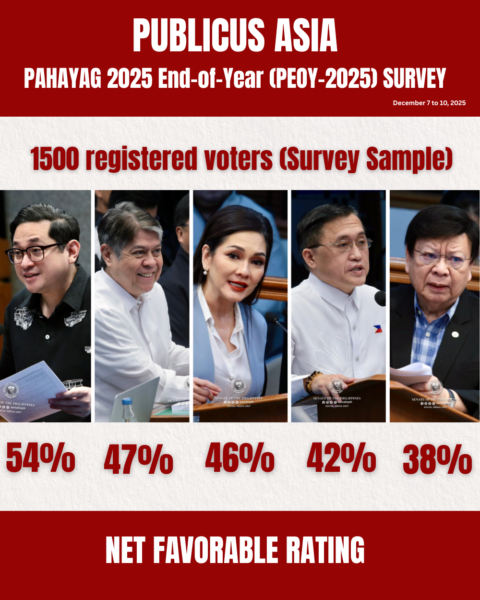
CAGAYAN DE ORO CITY ― Senator Paolo Benigno “Bam” Aquino IV has cemented his status as the country’s most favorably viewed lawmaker, securing a 54% net favorable rating in the latest independent survey. But behind the numbers lies a strategy of aggressive, systemic reform — from closing the classroom gap to digitizing government contracts.
Strategic consulting firm PUBLiCUS Asia, Inc. released the results of its Pahayag 2025 End-of-Year (PEOY-2025) survey this week. Conducted from Dec. 7 to 10 with 1,500 registered voters, the data highlights a shift in the political landscape, with Aquino leading a mix of majority and minority figures in the top five:
Francis “Kiko” Pangilinan (Majority): 47%Risa Hontiveros (Minority): 46%Bong Go (Minority): 42%Rodante Marcoleta (Minority): 38%
Since returning to the Senate with 20.8 million votes in the 2025 midterm elections, Aquino has positioned himself as the chamber’s premier “high-output” legislator, diving immediately into the country’s most pressing infrastructure and transparency failures.
The ‘Classroom Crusader’
Recognized as the “Classroom Crusader,” Aquino, now Chair of the Senate Committee on Basic Education, has launched a campaign to dismantle the nation’s education infrastructure crisis. His flagship measure, the Classroom-Building Acceleration Program (CAP) Act (Senate Bill 1482), aims to decentralize school construction.
The bill empowers local government units (LGUs) and non-governmental organizations to build facilities directly, a move designed to close the 165,000-classroom gap within six years.
“Lahat ho tayo nagulat nung nalaman natin na bente dos lang ang classroom na ginawa ng DPWH ngayong taon,” Aquino said, emphasizing the urgency of the crisis. “Ang backlog po natin 145,000 pataas, kaya yung bente dos na pagawa ng DPWH hindi po talaga yan katanggap-tanggap.
”The CAP Act has since been adopted as a priority measure by the Legislative-Executive Development Advisory Council (LEDAC).
Digitizing Transparency
Beyond education, Aquino has leveraged his role as Chair of the Science and Technology Committee to push for modern governance. This December, he successfully steered the CADENA Act (SB 1506) through its third reading.
A first for the Philippines, the law mandates a blockchain-based portal for the real-time tracking of every government contract. By making records tamper-proof and fully auditable by the public, the measure aims to eliminate “invisible hands” in the national budget.
“Sa dulo po ng lahat, iisa pa rin ang pinaglalaban natin – transparency, accountability, at sa pagiging bukas sa pagbusisi ng budget ng ating gobyerno na siya pong pera ng taumbayan,” Aquino said.
He added: “Solusyon at serbisyo para sa taumbayan, iyan po ang hangarin ng batas na ito. Siyempre po, para labanan ang corruption, ang CADENA Act ay isa sa pinakaklarong paraan para mabantayan ng taumbayan ang paggastos ng kanilang buwis.
”This commitment to transparency extended to the budget deliberations. Aquino led the call to livestream the 2026 Bicameral Committee meetings to prevent “midnight deals” in the P1.38-trillion education budget, which currently stands at a historic 4.5% of GDP.
Systemic Reforms and Future PrioritiesAquino continues to challenge the status quo with the filing of the Party-List Reform Act (SB 1559). The bill seeks to return the party-list system to its original intent as a voice for the marginalized by targeting “dynastic capture.
”Key provisions include disqualifying relatives of incumbents up to the third degree of consanguinity, banning government contractors from serving, and mandating evidentiary public hearings for registrants to prove their track record.
Additionally, he filed the Independent People’s Commission (IPC) Act (SB 1512) to create an independent body for investigating government corruption.
Looking ahead to 2026, Aquino has signaled new priorities: the “Angat Sweldo Para sa Guro” Act, proposing a significant salary adjustment for public school teachers, and the E-Textbook Para sa Lahat Act to bridge the digital divide in rural areas.
Currently, four legislative measures championed by Aquino are on the LEDAC priority list, signaling a rare alignment between the Senate majority and the Palace on the twin goals of transparency and education reform.