GOVERNMENT audit reports use specific language that can be confusing. Here is a breakdown of the key terms used in this report and what they mean for public funds.
GOVERNMENT audit reports use specific language that can be confusing. Here is a breakdown of the key terms used in this report and what they mean for public funds.
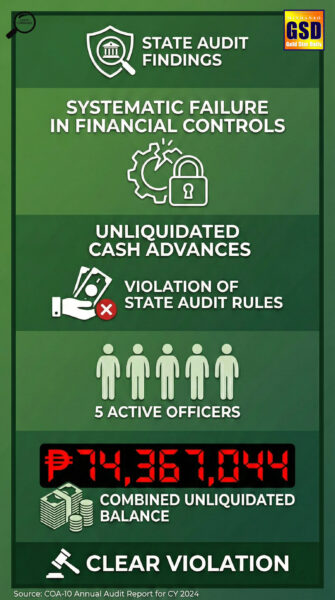
Unliquidated Cash Advance
What it means: Money given to an official for a specific purpose (e.g., travel, events) that has not yet been accounted for with receipts.
The Myth: It does not automatically mean the money was stolen.
The Reality: It means the money is “floating.” Until receipts are submitted, there is no proof the money was used correctly. If an official fails to produce receipts, they are required by law to return the cash.
Why it matters: When millions remain unliquidated, it suggests a lack of discipline and opens the door for funds to be used for personal reasons without detection.
Disallowance
What it means: When COA officially rejects an expenditure because it was illegal, irregular, unnecessary, or excessive.
The Consequence: The “Doctrine of Personal Liability.” If an expense is disallowed (like the “Klarexville” signage potentially could be), the public official who approved it must pay the money back to the government from their own personal pocket. The government does not foot the bill for illegal spending.
Utilization Rate
What it means: The percentage of the budget actually spent on projects.
The Context: In personal finance, saving money is good. In government, a low utilization rate (like the city’s 4.47% for development funds) is bad.
Why it matters: It means money is sitting in the bank instead of turning into roads, drainage, or medicines. It is effectively “service denied” to the taxpayers who funded it.
Reversion
What it means: The “use it or lose it” rule.
The Rule: Certain funds (like the disaster fund) have a lifespan (usually 5 years). If the city doesn’t use the money within that time, it must be returned (reverted) to the General Fund so it can be re-budgeted for other needs.
The Finding: COA flagged the city for keeping expired funds in limbo, preventing that money from being reused for new social programs.
Internal Control
What it means: The checks and balances system (signatures, pre-audits, separation of duties).
The Breakdown: When COA cites a “systematic failure” in internal control, they are saying the “gatekeepers” (accountants, administrators) are approving transactions (like new cash advances) that should have been blocked by the rules.
To read the full audit report click here: 5 Oro officials hold P74M in unliquidated cash: COA flags ‘systematic failure’