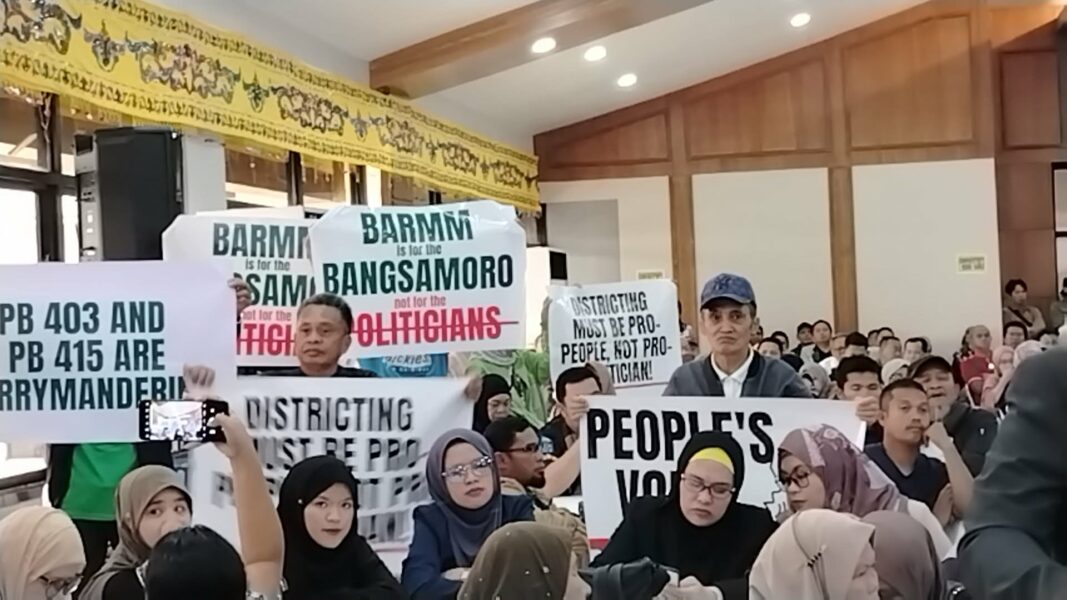
MARAWI City — The drawing of new parliamentary district lines in the Bangsamoro region has sparked a debate between political pragmatism and historical preservation, as stakeholders voiced strong opinions during a recent series of public consultations.
The Bangsamoro Transition Authority (BTA) led discussions in Cotabato City, Marawi City, and Maguindanao del Norte to scrutinize six proposed bills — BTA Bills 403, 407, 408, 411, 415, and 416 — that seek to reorganize the apportionment of district representative seats in the Bangsamoro Autonomous Region in Muslim Mindanao (Barmm).
While the consultations aimed to gather technical input, the dialogue quickly turned to the cultural and historical implications of redrawing the map.
Preserving historical ties
In Marawi, the debate centered on the preservation of community bonds. Tasnim-Jannah Maongco Edris, representing the local government of Kapai, vehemently opposed proposals that would separate the towns of Kapai and Tagoloan II into different districts.
“We ask the BTA to respect and safeguard the strong ties that bind our towns… we stand firmly against any division that would sever this bond under our shared heritage and break the collaborative bonding that we have diligently build,” Edris said.
She emphasized that political boundaries should not come at the cost of cultural identity.
“Correct representation should not be begged for — it is the Parliament’s obligation to enforce genuine and rightful representation,” she added, throwing her support behind BTA Bill 407, which she noted maintains the historical contiguity recognized by the Supreme Court.
The youth demand integrity
The consultations also served as a platform for the region’s younger generation to demand accountability. Faykha Alonto, Speaker of the Ranaw Youth Parliament, urged the BTA to look beyond political maneuvering.
“BTA, show courage — courage to prioritize integrity, to remove political interests, and to unite for the Bangsamoro,” Alonto said. “For us, the youth, our call is simple: deliver. Redistricting is not about who wins or loses but about justice, representation, and the right direction for the Bangsamoro.”
Tensions during the discussions prompted Taraka Mayor Nashiba Gandamra Sumagayan, representing a coalition of mayors, to appeal for civility.
“Mr. Presiding Officer, let us maintain professionalism and uphold respect in all our discussions. These proposals are open for sincere deliberation,” she said.
Moving toward consensus
Despite the divided views, BTA Bills 403 and 407 emerged as the frontrunners, receiving the most significant backing from stakeholders.
Deputy Speaker Amenodin Sumagayan, who presided over the Marawi session, assured the public that the committee consolidation process would respect the people’s will.
“All inputs from stakeholders will form part of the consolidated version of the proposal. We will give the people the opportunity to choose where they are more comfortable,” Sumagayan said.
He reaffirmed that the first Barmm parliamentary elections will proceed once the redistricting bill is passed and the Commission on Elections (Comelec) completes the required 120-day preparation period.
Sumagayan closed the consultation with a reminder of the high stakes involved in this political experiment.
“Let us support each other, especially our members of parliament, as they work on the redistricting bill which is crucial for the BARMM election. Let us protect this government,” Sumagayan said.
He added: “This is the first parliamentary government in the Philippines under a presidential system. It is experimental and we cannot afford to fail. I hope everyone supports this effort for the success of the Bangsamoro Government.”
The consultation series, which began with a session led by lawyer Naguib Sinarimbo in Cotabato City, is scheduled to conclude its final leg on Dec. 9 in Sultan Kudarat, Maguindanao del Norte.
Other Members of Parliament present included Basit ‘Jannati Mimbantas’ Abas, Abdullah G. Macapaar, Rashdi T. Adiong, Ali B. Solaiman, Said M. Shiek, Alirakim T. Munder, and Ameer Zaakaria A. Rakim.