IF you’ve ever felt like the rules of the world are rigged against you, a new Oxfam study confirms that when it comes to climate change, they absolutely are.
In an emailed report today, Nov. 3, titled ‘Climate Plunder: How a powerful few are locking the world into disaster,’ reveals a staggering chasm in carbon emissions: the world’s richest 0.1% produce more carbon emissions in a single day than the poorest 50% generate all year.
The sheer scale of the disparity is shocking. Data shows that the richest 0.1% generate an average of 800 kg of CO2 daily — roughly the weight of a small sedan — while the poorest half of humanity emits a paltry 2 kg, comparable to the weight of a large bottle of water.
Oxfam warns that if the rest of humanity were to adopt the emission habits of the ultra-rich, the world’s entire carbon budget would be exhausted in under three weeks.
The study, which spans data from 1990 to 2022, emphasizes that the crisis isn't just about lavish consumption, but about the economic power driving it.
The average billionaire’s investments alone produce 1.9 million tons of CO2 a year, an amount equivalent to nearly 10,000 private jet trips around the world.
Even more damning: 60% of billionaire investments are channeled into high climate-impact sectors like oil and mining, resulting in portfolios that emit 2.5 times more than an average S&P Global 1,200 investment.
The investment portfolios of just 308 billionaires were found to generate more emissions than those of 118 countries combined.
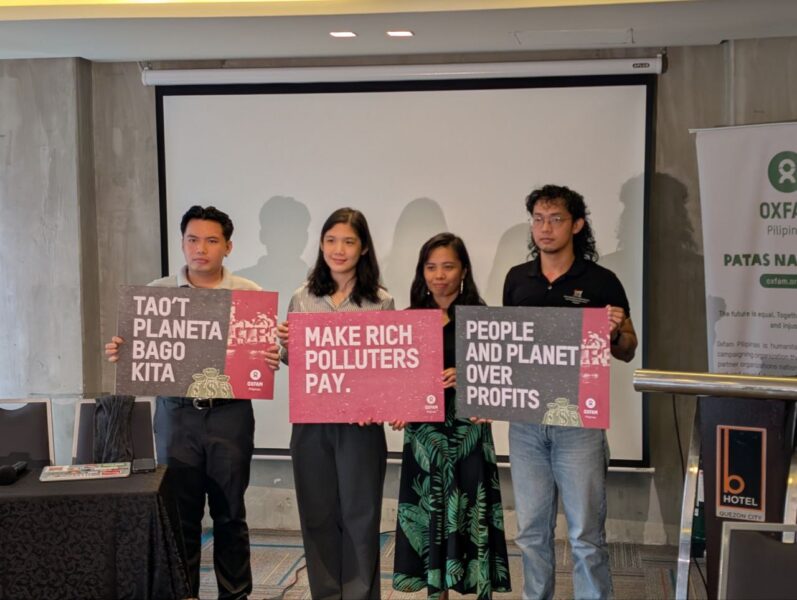
Cheng Pagulayan, Oxfam Pilipinas Climate Justice Portfolio Manager, didn't mince words about what this means on the ground.
“The worsening climate crisis is an inequality crisis. Our report shows that the world's wealthiest are amassing not only wealth but also political power that influences decisions and drives us all deeper into climate destruction," Pagulayan said.
The problem isn’t just global; it’s a deeply localized crisis of governance and accountability. Pagulayan highlighted how this ‘climate plunder’ manifests in the Philippines:
“In the Philippines, billions earmarked for flood control have reportedly been diverted into ghost and substandard projects — leaving people and communities vulnerable many times over to intensifying storms, floods, and other disasters. That is climate plunder in practice: public resources meant to reduce climate risk are captured by a powerful few, worsening vulnerability for the ordinary Filipinos," the Oxfam report reads in part.
This is further exacerbated by the super-rich leveraging their influence to actively weaken climate policy. At the last UN Climate talks (COP29), 1,773 coal, oil, and gas lobbyists were granted access, a figure that alarmingly outnumbered the total number of delegates from the 10 most climate-vulnerable nations.
As the world looks ahead to the 2025 United Nations Climate Change Conference (COP30) in Brazil, Oxfam’s message is clear: the wealthy must take radical, disproportionate action.
The report warns that to meet the Paris Agreement target of limiting global warming to 1.5°C, the richest 0.1% must slash their per capita emissions by a staggering 99% by 2030.
Failure to act means the emissions of the richest 1% alone are enough to cause an estimated 1.3 million heat-related deaths and $44 trillion in economic damage to low-income countries by the end of the century.
Oxfam is now pushing governments worldwide to fundamentally dismantle the political and economic power of the super-rich by advocating for several key measures, including the implementation of extreme wealth taxes and excess profits taxes on fossil fuel corporations.
The organization also calls for banning fossil fuel corporations from climate negotiations like COP to curb their influence.
Economically, Oxfam urges a shift away from dominant neoliberal economics towards a system grounded in sustainability and equality.
The organization urges nations to commit to a “fair-share” approach for Nationally Determined Contributions (NDCs) that accurately reflects their historical responsibility and capacity to act on climate change.