By Eman D. Pangcatan
MSU Intern
THEY aren’t supposed to be there — but they are.
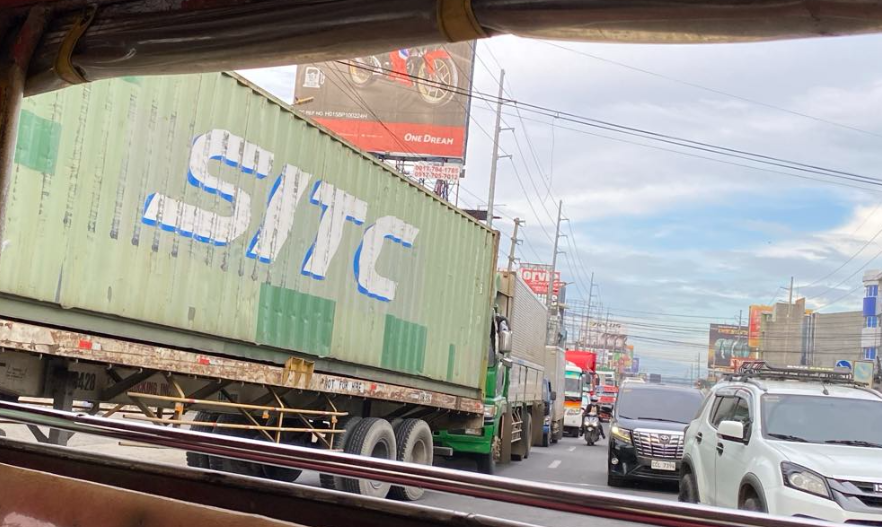
Despite a 19-year-old truck ban meant to ease Cagayan de Oro’s daily traffic gridlock, heavy haulers continue to thunder through the city’s busiest roads as if nothing ever changed.
Ordinance No. 10551-2007, passed March 19, 2007, by the Sangguniang Panlungsod, is the city’s official Traffic Code. It was created to address the rising tide of road congestion and safety concerns, particularly from large delivery trucks clogging major routes during peak hours.
Under Article 15, Section 97, trucks are prohibited from traveling between 7 to 9 am and 5 to 7 pm, but may operate outside those hours in designated zones including Poblacion, Cogon, Carmen and Puerto Market, with certain windows extending from 6 to 10 am and 3 to 7 pm.
Section 98 offers conditional exemptions, allowing trucks to pass through CM Recto Avenue — but only if they are in direct transit to Butuan or Iligan City.
But what’s stopping a truck driver from simply claiming they’re heading out of town while actually going to a nearby garage or switching shifts?
A loophole in motion
The loophole lies in the lack of verification.
There is no specific citation in the ordinance or from the Department of Public Works and Highways (DPWH) that mandates trucks to use alternative national highways such as the N9 (Butuan–Cagayan de Oro–Iligan Road) or the N10/AH26 (Sayre Highway).
What exists are informal city traffic bulletins and routing advisories, nothing that legally binds or tracks where these trucks are headed once they hit CM Recto.
To make matters more complicated, existing alternative routes like the Coastal Road, which was intended to help divert heavy vehicles, are not fully equipped to handle the size and volume of cargo trucks regularly entering the city.
With its limitations in infrastructure, space, ongoing constructions and connectivity, the coastal route has proven insufficient for consistent heavy truck traffic, pushing many drivers to continue using restricted roads — particularly those covered by the truck ban.
This scenario creates a perfect storm of ambiguity and necessity: drivers have limited alternatives, enforcement officers have no real tools to confirm a truck’s destination, and the result is traffic chaos at the city’s most critical junctions.
Digital push, public pressure
The issue resurfaced online after Gold Star Daily published an article calling attention to repeated truck ban violations.
The Roads and Traffic Administration (RTA) quickly responded with an infographic explaining Sections 97 to 99. The post drew 16 comments, including two from the RTA itself, and reignited citizen scrutiny.
Ethel Mae Gabutina, a concerned citizen, didn’t hold back: “I hope this will be strictly implemented. I raised this issue BEFORE the pandemic, and I was just brushed off… The ordinance has been there lurking in the corner waiting to be implemented.”
Another user, Toti Sam, echoed what many feel during rush hour: “Ay salamat, grabee ka traffic gyud.”
Still stuck in traffic
Despite the renewed focus, real-time incidents tell another story.
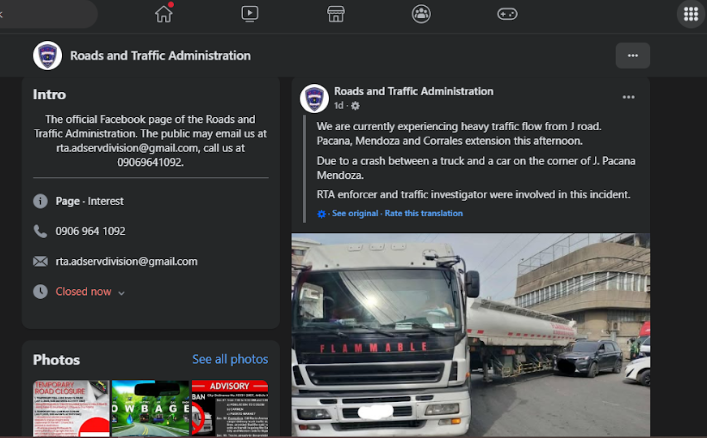
The RTA’s own Facebook page reported a collision between a truck and a car at the corner of J. Pacana, Mendoza and Corrales Extension, triggering major delays.
Another post warned of heavy traffic near the Cugman–Baloy Bridge after a similar incident involving a private vehicle and a truck.
Both updates concluded with familiar calls for patience and caution. But for many commuters, patience is wearing thin.
Not a bad law — just badly enforced?
To be clear: This isn’t an attack on the ordinance. In fact, Ordinance No. 10551-2007 is widely seen as sound, relevant and necessary. The problem isn’t the policy — it’s the inconsistent and unclear enforcement.
Without stricter tracking of truck routes, legal designations of alternate highways and reliable on-the-ground enforcement, the city risks allowing a good law to fade into irrelevance.
And so, the question lingers — not in courtrooms or council sessions, but in the honking chaos of rush hour: If the law exists, why does the traffic still look like it doesn’t?