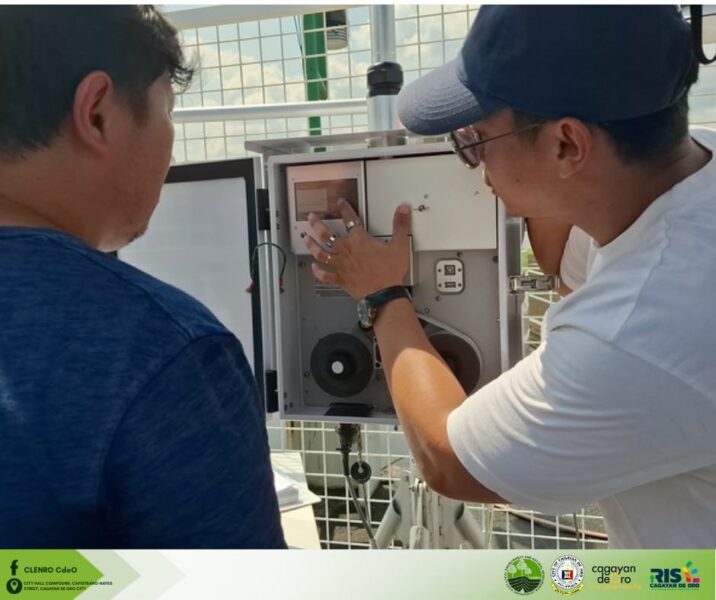
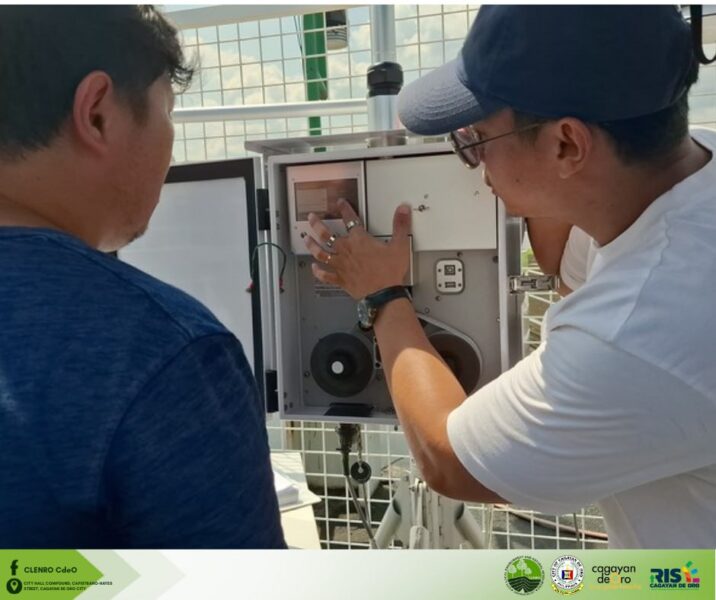
CAGAYAN de Oro City’s Local Environment and Natural Resources Office (Clenro) installed a newly purchased air monitoring device on the roof deck of the City Hall executive building last week.
The air monitoring device is designed to measure pollutants from vehicle and industrial facility emissions, specifically particulate matter 2.5 and 10 (PM 2.5 and PM 10). Recent studies show that prolonged exposure to PM 2.5 affects the respiratory system; when inhaled, the tiny particles travel deeply into the lungs and bloodstream, worsening respiratory conditions such as asthma and heart disease.
While Clenro did not disclose the cost of the device, research by Gold Star Daily revealed that former Clenro chief Armen A. Cuenca had previously mentioned the city government allocated P17 million in this year’s budget for purchasing air quality monitoring equipment.
“This machine will measure all kinds of particles in the air. This is one of the big purchases we are preparing by 2025,” Cuenca earlier said, as reported by the Philippine News Agency.
The city government purchased the Environmental Beta Attenuation Mass Portable Beta Gauge, or E-BAM PLUS, coinciding with the celebration of Clean Air Month.
“This technology enables the city to gather accurate air quality data, raise public awareness, and strengthen efforts toward cleaner and healthier air for the community,” Clenro noted in a social media post. The office stated this was in line with Republic Act No. 8749, or the Philippine Clean Air Act of 1999.
According to the City Information Office (CIO), Clenro manager Elvisa Mabilin said the device can measure air quality from City Hall to the edges of Barangays Indahag, Macabalan, Bonbon, Bulua, and Kauswagan, and extending up to the dumpsite in Upper Zayas.
The CIO also noted that Clenro plans to develop a mobile application (app) for residents to check daily air quality results or to connect the results to the city’s LED wall for public display.
For historical context, the Department of Environment and Natural Resources (DENR) partnered with Xavier University-Ateneo de Cagayan in 2002 to install the country’s first state-of-the-art Open Path Air Quality Monitoring Station, which was said to have various advantages over a conventional air monitoring system.