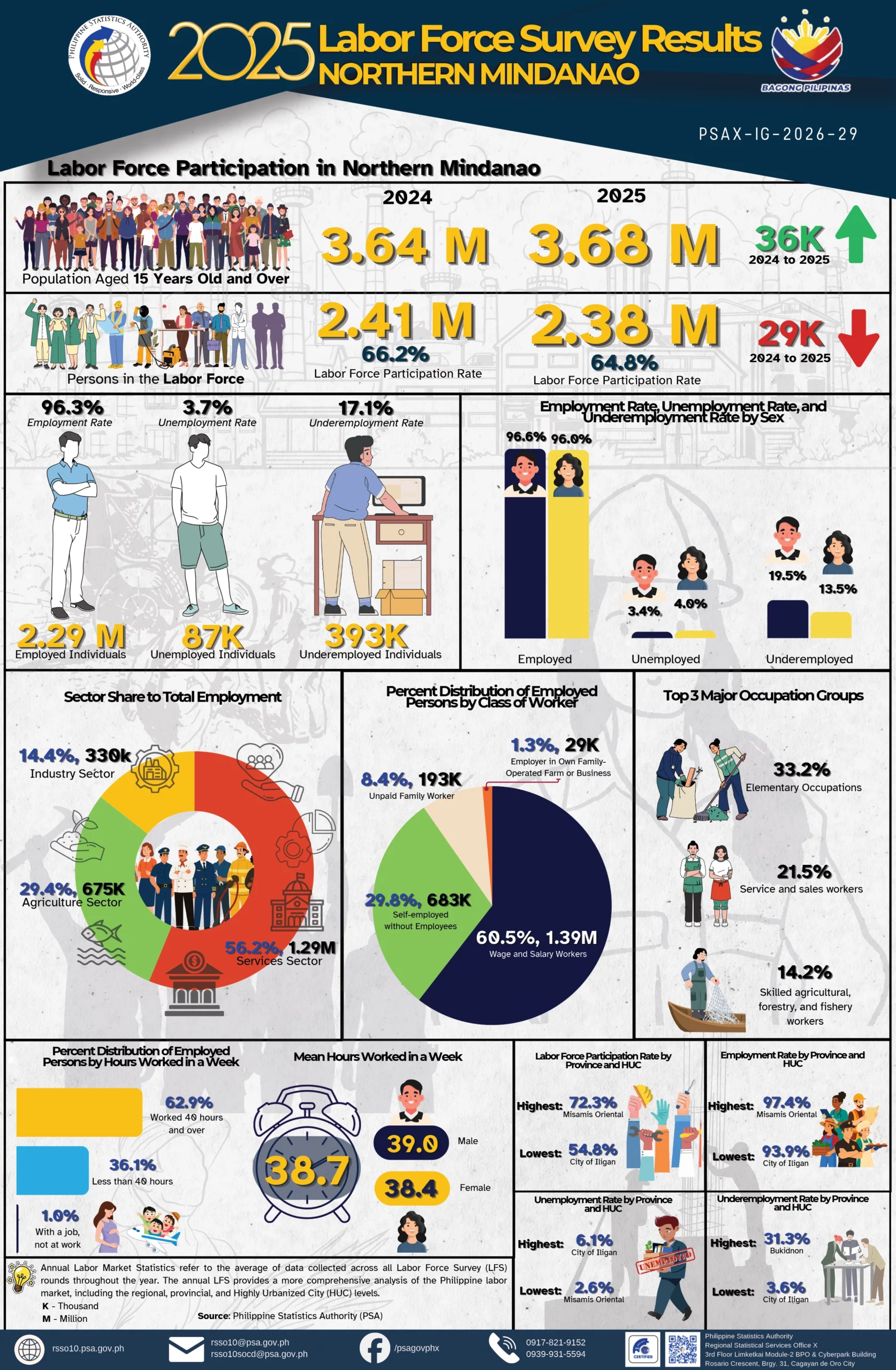
CAGAYAN DE ORO CITY — Northern Mindanao’s labor market presents a conflicting landscape for policymakers and business leaders. While the region's top-line employment rate ticked up slightly to 96.3% in 2025, underlying data from the Philippine Statistics Authority (PSA) reveal an unsettling economic reality — a massive structural job loss in agriculture and a sharp spike in part-time workers demanding more hours.
The region’s total labor force participation shrank from 66.2% to 64.8%, leaving the active workforce pool at 2.38 million individuals. Although fewer people looked for work—which lowered the official unemployment rate to 3.7% (87,000 individuals)—the net volume of actual employed workers dropped by 30,000, sliding down to 2.29 million.
The Structural Shift: Services Rise as Agriculture Bleeds
The service industry has firmly cemented its position as Northern Mindanao's primary economic engine, now accounting for 56.2% (1.29 million) of all regional jobs. This growth was led by steady gains in the education (+17,000), public administration (+13,000), and tourism-related hospitality (+12,600) sectors.
In sharp contrast, the traditional bedrock of the Mindanao economy experienced a severe downturn. The agriculture and forestry sub-sector lost 97,000 workers in 2025, dropping from 722,000 to 625,000. This marks the single largest annual employment contraction across all sectors in Region X. A 16,000-job gain in fishing and aquaculture partially offset this drop, leaving the broader agricultural sector with a net loss of 81,000 jobs. Despite the slump, agriculture remains the region's second-largest employer at 29.4%.
PSA indicators highlight several clear factors behind this shift, led primarily by job volatility, as 45.3% of workers cited variable working hours or irregular tasks as the main reason for reduced employment output. Climate pressures also played a role, with bad weather conditions and natural disruptions directly forcing 2.2% of the labor pool into part-time schedules. Furthermore, shifting market dynamics, such as low seasonal cycles (0.9%) coupled with poor business conditions and a shrinking client base (3.0%), limited full-time farming work. This structural volatility drove the regional underemployment rate up to 17.1%, meaning 393,000 workers are currently holding jobs but actively looking for more working hours to make ends meet.
The Gender and Youth Disparity
The updated data highlights persistent demographic gaps across the workforce. Regarding gender imbalance, male labor force participation stands at 76.3%, far outstripping female participation at 52.6%. Men also experience higher underemployment at 19.5% compared to women at 13.5%, showing that while more men find work, their jobs are often less stable.
Youth attrition has also emerged as a significant policy concern, with participation among individuals aged 15 to 24 dropping significantly from 36.0% to 33.8%. Alarmingly, the youth NEET rate—representing those not in education, employment, or training—ticked up to 13.7%, pointing to a growing segment of vulnerable young citizens disconnected from local economic tracks.
Geographical Divide: Misamis Oriental Leads, Iligan Slumps
The economic performance across different provinces and highly urbanized cities (HUCs) varies widely, revealing distinct localized economic climates:
Misamis Oriental emerged as the region's top performer, posting the highest labor participation rate at 72.3% and the highest overall employment rate at 97.4%, while keeping unemployment at a low 2.6%.
Conversely, Bukidnon showed growing signs of economic strain. While its overall employment rate of 96.4% sits just above the regional average, the province logged the highest underemployment rate in Northern Mindanao at a staggering 31.3%, indicating that nearly one-third of Bukidnon's workforce is underemployed and struggling to secure stable, full-time hours.
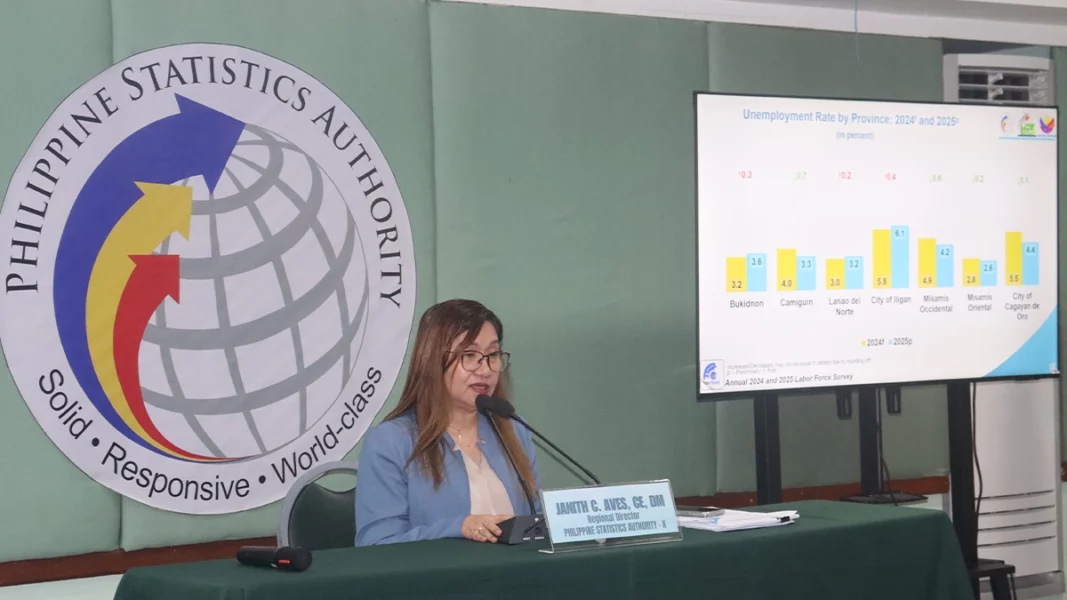
Among the highly urbanized cities, Cagayan de Oro City demonstrated steady progress. The city's total working-age population grew to 544,000, helping lift its employment rate to 95.6% and lowering unemployment to 4.4%. Notably, Cagayan de Oro recorded the lowest underemployment rate in the entire region at 5.5%, demonstrating high job stability and quality for those within its urban center.
Iligan City, however, posted the lowest metrics in the region. The city recorded the lowest labor participation rate at 54.8% and the lowest overall employment rate at 93.9%. Its unemployment rate rose to 6.1%, making it the highest in Northern Mindanao. Interestingly, Iligan also recorded the lowest underemployment rate at 3.6%, suggesting that while jobs are notably harder to find in Iligan, the small portion of the population that is employed holds secure, full-time positions.