CAGAYAN DE ORO CITY — Northern Mindanao maintained a strong employment rate in 2025, keeping over 96% of its active workforce employed. However, the region's total labor pool—covering both employed individuals and active job seekers—shrank to 2.38 million, marking a drop of roughly 29,000 people from the 2.41 million recorded in 2024.
According to data released by the Philippine Statistics Authority-10 (PSA-10) during a presscon on May 20, 2026, beneath these stable headline numbers lie significant gaps in job quality across different genders, sectors, and geographic areas.
Gender and Job Gaps
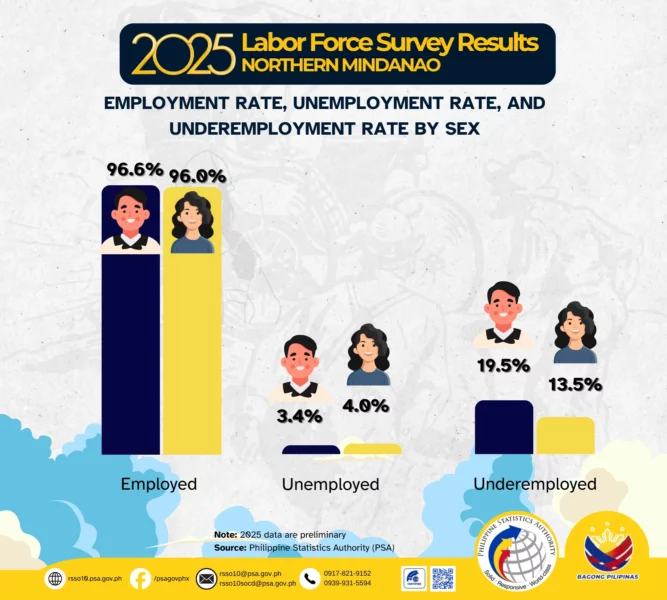
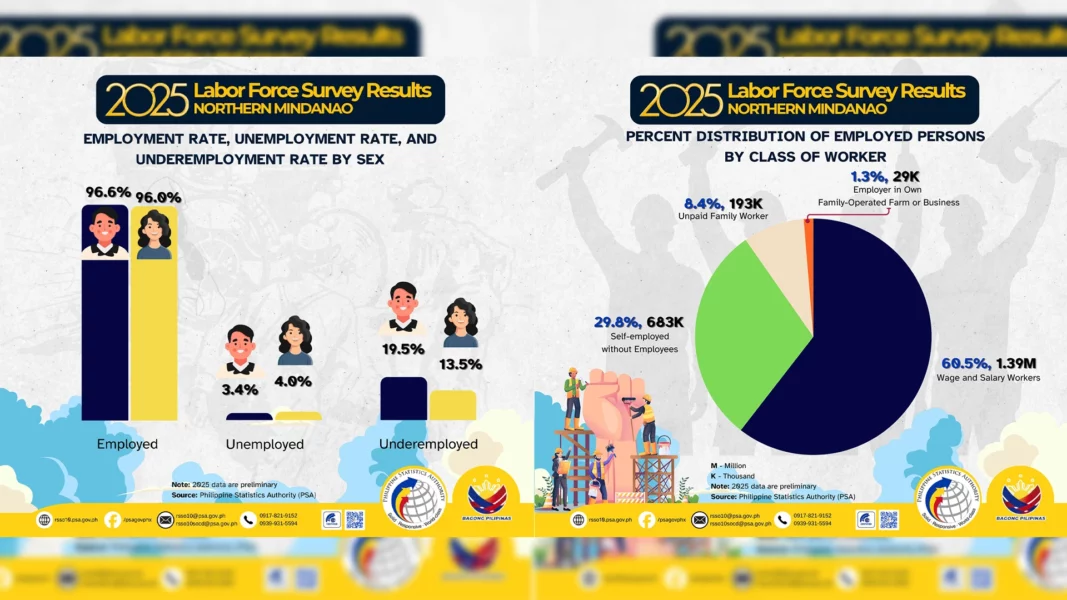
While overall employment remained high, men and women experienced the local job market differently. Men posted a 96.6% employment rate, slightly outpacing the female rate of 96.0%. Consequently, female unemployment stood at 4.0%, compared to 3.4% for males.
You may also like: MBHTE controversy rooted in alleged corruption, says Macacua
The gap widened significantly in underemployment, which tracks workers wanting more hours or an additional job. The regional underemployment rate was much higher among men at 19.5% than women at 13.5%, meaning that nearly one in five working men struggled to secure sufficient hours to make ends meet.
Employment Breakdown
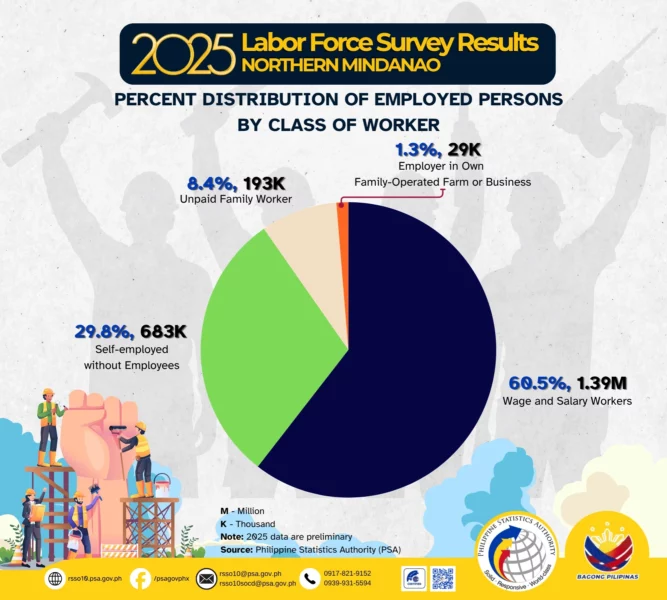
Most workers in Northern Mindanao rely on fixed wages, though entrepreneurship and farming remain major pillars. Wage and salary workers comprised 60.5% of the working population, followed by self-employed individuals at 29.8%, unpaid family laborers at 8.4%, and family business or farm operators at 1.3%.
In terms of weekly schedules, 62.9% of the workforce clocked in at least 40 hours per week, bringing the regional average to 38.7 hours. The local economy remains heavily anchored by manual labor, commerce, and agriculture. Basic elementary occupations made up the largest share of the job market at 33.2%, followed closely by service and sales jobs at 21.5%, and agricultural, forestry, or fishery work at 14.2%.
Provincial Contrasts
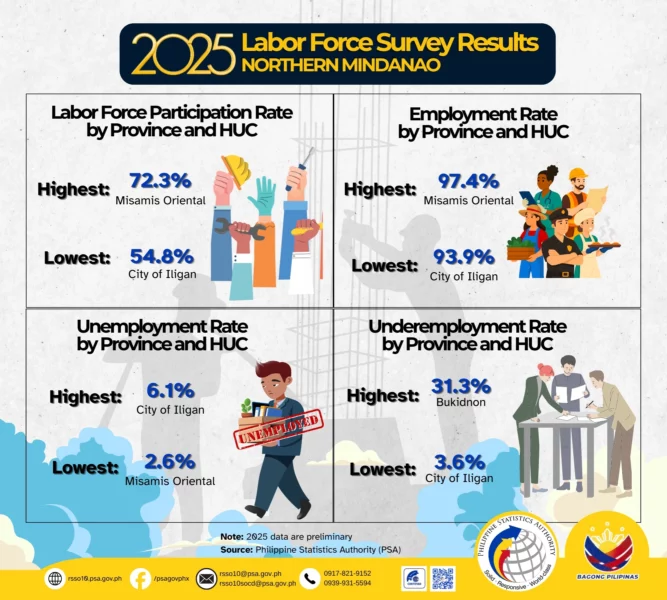
The survey exposed sharp economic contrasts across Northern Mindanao’s local government units, drawing a clear line between the region's top and bottom performers. Misamis Oriental emerged as the strongest economy, posting the highest workforce engagement rate at 72.3% and a stellar 97.4% employment rate.
In stark contrast, Iligan City registered the weakest numbers, logging the lowest workforce engagement at 54.8%, the lowest employment rate at 93.9%, and the region's highest unemployment rate at 6.1%.
Meanwhile, Bukidnon faced the toughest job quality issues. The agricultural province logged a staggering 31.3% underemployment rate, meaning nearly a third of its employed population requires more hours or a better-paying job. Conversely, Iligan City kept its underemployment exceptionally low at just 3.6%.