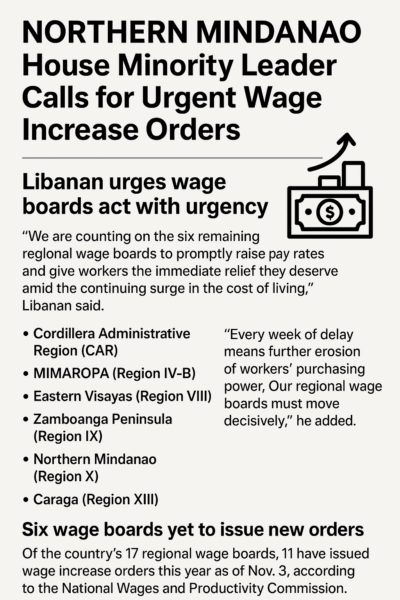
NORTHERN Mindanao is one of six regions still expected to issue new minimum wage increase orders before the end of the year. The expectation comes as House Minority Leader and 4Ps Party-list Rep. Marcelino ‘Nonoy’ Libanan pressed wage boards to act swiftly amid rising consumer prices.
“We are counting on the six remaining regional wage boards to promptly raise pay rates and give workers the immediate relief they deserve amid the continuing surge in the cost of living,” Libanan said.
He warned that “every week of delay means further erosion of workers’ purchasing power. Our regional wage boards must move decisively.”
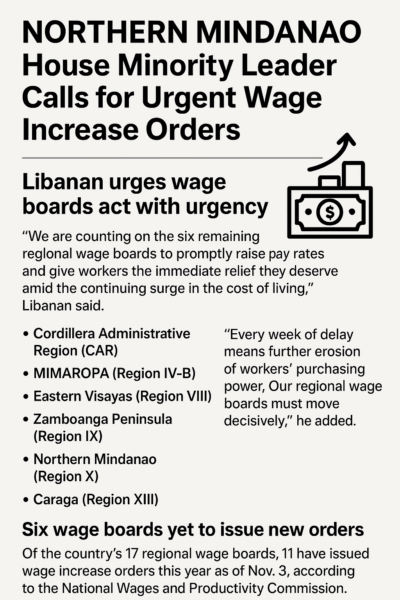
Of the country’s 17 regional wage boards, 11 have already issued new wage increase orders this year as of Nov. 3, according to the National Wages and Productivity Commission.
The remaining regions are: the Cordillera Administrative Region, Mimaropa, Eastern Visayas, Zamboanga Peninsula, Northern Mindanao, and Caraga.
The most recent order came from Western Visayas, where the wage board approved a P40 increase on Oct. 23, raising the minimum wage to P550 effective Nov. 19.
Libanan pointed out that wage hikes are not only about fairness but also vital to economic recovery.
“The country urgently needs wage adjustments to revive household consumption spending, which has been weakened by months of wage erosion caused by sustained price hikes,” he said.
He added: “Boosting household spending is essential if we want to strengthen demand for goods and services, accelerate economic growth, and spur job creation in the months ahead.”
The urgency is underscored by recent data.
A Pulse Asia survey conducted Sept. 27–30 ranked “increasing the pay of workers” as the third most urgent national concern, after inflation control and anti-corruption efforts. Fighting criminality and reducing poverty rounded out the top five.
The Philippine Statistics Authority, in its latest report, stated that the country’s gross domestic product grew 4.0 percent in the July to September quarter, slower than the 5.5 percent recorded in April to June, partly reflecting weaker household spending due to diminished purchasing power.