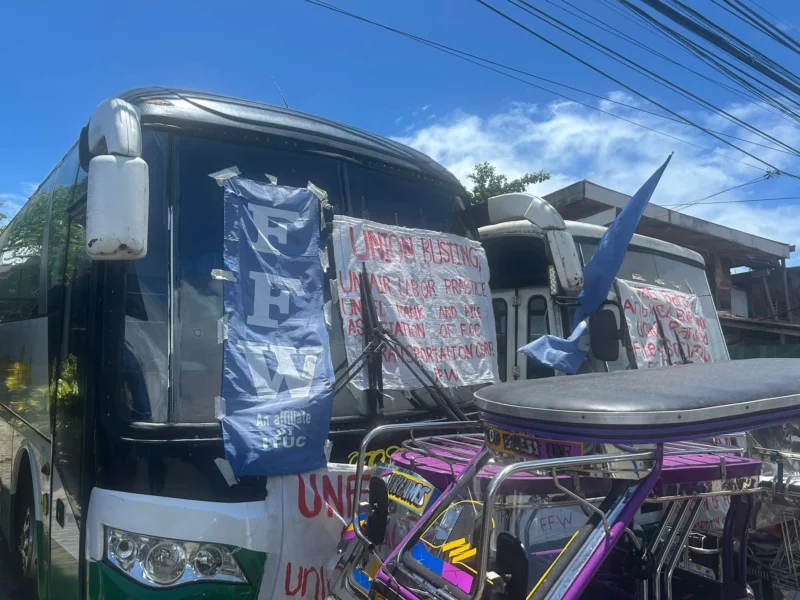
A labor group is urging Congress to revisit provisions of the Labor Code that impose severe penalties on workers involved in illegal strikes, following a work stoppage by members of the Senate majority that sparked debate on accountability in public service.
In a June 2 statement and a June 4 response to this paper's queries, the Federation of Free Workers (FFW) questioned what it described as a double standard between ordinary workers and elected officials when work disruptions occur.
FFW National President and Nagkaisa Labor Coalition Chairperson Atty. Sonny Matula likened the recent Senate work stoppage to a "wildcat strike," a term used in labor relations to describe a strike conducted without the required legal procedures or union authorization.
"No notice of strike. No strike vote. No mediation. Just a stoppage of work," said FFW Acting President Jun Mendoza Ramirez. "It appears the Senate majority has discovered a new form of industrial action—a wildcat strike by legislators."
Read also: 300 fired steel workers: Lawyers step in after Misor raid
The labor group used the incident to renew its call for reforms to Labor Code provisions governing illegal strikes.
Under current labor laws and jurisprudence, union officers who knowingly participate in an illegal strike may lose their employment status, while rank-and-file workers may be terminated for knowingly committing illegal acts during a strike.
Asked which specific provisions the FFW wants Congress to amend, Matula pointed to Article 279 of the Labor Code, formerly Article 264, which governs prohibited activities during strikes.
"Any union officer who knowingly participates in an illegal strike and any worker or union officer who knowingly participates in the commission of illegal acts during a strike may be declared to have lost his employment status," Matula quoted from the law.
Matula said the provision has resulted in severe consequences for workers and union leaders in several labor disputes, citing cases involving FFW-affiliated unions.
"In Interphil Laboratories Employees Union-FFW v. Interphil Laboratories, Inc., the Supreme Court treated an overtime boycott and work slowdown as an illegal strike and upheld the loss of employment status of union officers," he said.

He added that similar rulings were handed down in University of San Agustin Employees' Union-FFW v. Court of Appeals and Asionics Philippines v. NLRC, where findings of illegal strikes likewise carried the grave consequence of job loss for union officers.
"The reason why FFW says Article 279 should be reviewed is simple: labor peace should not require the industrial death penalty," Matula said.
Matula said the labor federation is unaware of any pending measure in Congress that would directly remove the penalty of loss of employment for union officers who knowingly participate in an illegal strike.
"At present, FFW is not aware of any pending measure in the present Congress that directly removes the penalty of loss of employment for union officers who knowingly participate in an illegal strike," he said.
"We believe Congress should revisit Article 279 of the Labor Code and consider whether dismissal remains a proportionate penalty in light of constitutional guarantees of freedom of association and the right to concerted activities."
FFW President Emeritus and labor lawyer Allan Montaño said the current sanctions are disproportionately harsh compared with accountability mechanisms imposed on public officials.
"Loss of employment is too severe a penalty for workers exercising collective action, especially when they are asserting labor rights," Montaño said. "Congress should review and amend the provisions governing illegal strikes."
The group also highlighted the principle of "no work, no pay," which commonly applies to workers during strikes and work stoppages.
"Attendance muna bago sweldo. Kung ang manggagawa may kaltas kapag walang trabaho, dapat may pananagutan din ang mga opisyal kapag nahihinto ang serbisyo publiko," Montaño said.
What Workers Need to Know
Labor experts remind workers that the right to strike remains protected under the Constitution, but it must comply with legal requirements under the Labor Code.
These include filing a notice of strike, conducting a strike vote, observing cooling-off periods, and undergoing conciliation and mediation proceedings through the National Conciliation and Mediation Board (NCMB).
Failure to follow these procedures may expose workers and union officers to sanctions, including possible dismissal in cases defined by law and supported by due process.
The FFW said its appeal is not only about labor rights but also about ensuring fairness and accountability across all sectors, particularly when public services are disrupted.
The group urged lawmakers to study possible amendments that would strengthen workers' rights while maintaining industrial peace and protecting the public interest.