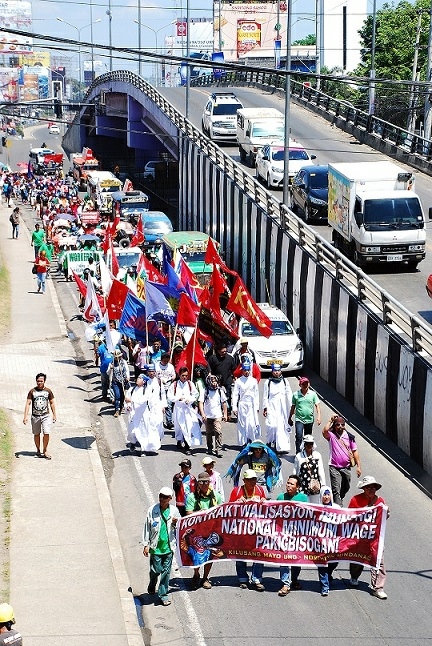
 MAY DAY. Workers from across northern Mindanao mark the 104th anniversary of Labor Day in the country with a march protest in the streets of downtown Cagayan de Oro yesterday. (PHOTO BY CONG B. CORRALES)
Their main demand is for national government to increase to P750 the daily minimum wage of workers across the board.
Barros pointed out that a P750 daily wage covers only 70 percent of the cost of living in region which is currently pegged at P1,119.
Increasing the workers’ wages, he added, would be beneficial to all parties in the long run. It is just simple economics, Barros said.
“By increasing the buying power of the workers, more workers can also buy the products these industries are producing,” Barros pointed out.
The workers also called out President Duterte on his campaign promise of ending contractualization of labor where according to the workers has been flip-flopping on the prospect of the regularization of workers across the country.
“He (Duterte) should define his stand on the issue clearly,” Barros said.
The first May Day was in 1886 when 200,000 workers in the United States launched a crippling nationwide strike to demand shorten the work hours per day from 12 hours to an eight-hour work day.
Here in the Philippines, the labor movement was first recognized by government on May 1, 1913 when its leaders convened a labor congress, according to the National Historical Commission.
More than a century ago, Congreso Obrero de Filipinas was formed and 10 years after the Katipunan ng Anak Pawis was formed which led protest actions in the country. Both labor congresses were outlawed by the government.
MAY DAY. Workers from across northern Mindanao mark the 104th anniversary of Labor Day in the country with a march protest in the streets of downtown Cagayan de Oro yesterday. (PHOTO BY CONG B. CORRALES)
Their main demand is for national government to increase to P750 the daily minimum wage of workers across the board.
Barros pointed out that a P750 daily wage covers only 70 percent of the cost of living in region which is currently pegged at P1,119.
Increasing the workers’ wages, he added, would be beneficial to all parties in the long run. It is just simple economics, Barros said.
“By increasing the buying power of the workers, more workers can also buy the products these industries are producing,” Barros pointed out.
The workers also called out President Duterte on his campaign promise of ending contractualization of labor where according to the workers has been flip-flopping on the prospect of the regularization of workers across the country.
“He (Duterte) should define his stand on the issue clearly,” Barros said.
The first May Day was in 1886 when 200,000 workers in the United States launched a crippling nationwide strike to demand shorten the work hours per day from 12 hours to an eight-hour work day.
Here in the Philippines, the labor movement was first recognized by government on May 1, 1913 when its leaders convened a labor congress, according to the National Historical Commission.
More than a century ago, Congreso Obrero de Filipinas was formed and 10 years after the Katipunan ng Anak Pawis was formed which led protest actions in the country. Both labor congresses were outlawed by the government.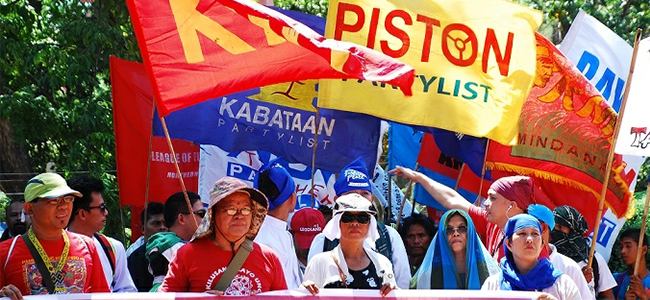 MAY DAY. Workers from across northern Mindanao mark the 104th anniversary of Labor Day in the country with a march protest in the streets of downtown Cagayan de Oro yesterday. (PHOTO BY CONG B. CORRALES)
Their main demand is for national government to increase to P750 the daily minimum wage of workers across the board.
Barros pointed out that a P750 daily wage covers only 70 percent of the cost of living in region which is currently pegged at P1,119.
Increasing the workers’ wages, he added, would be beneficial to all parties in the long run. It is just simple economics, Barros said.
“By increasing the buying power of the workers, more workers can also buy the products these industries are producing,” Barros pointed out.
The workers also called out President Duterte on his campaign promise of ending contractualization of labor where according to the workers has been flip-flopping on the prospect of the regularization of workers across the country.
“He (Duterte) should define his stand on the issue clearly,” Barros said.
The first May Day was in 1886 when 200,000 workers in the United States launched a crippling nationwide strike to demand shorten the work hours per day from 12 hours to an eight-hour work day.
Here in the Philippines, the labor movement was first recognized by government on May 1, 1913 when its leaders convened a labor congress, according to the National Historical Commission.
More than a century ago, Congreso Obrero de Filipinas was formed and 10 years after the Katipunan ng Anak Pawis was formed which led protest actions in the country. Both labor congresses were outlawed by the government.
MAY DAY. Workers from across northern Mindanao mark the 104th anniversary of Labor Day in the country with a march protest in the streets of downtown Cagayan de Oro yesterday. (PHOTO BY CONG B. CORRALES)
Their main demand is for national government to increase to P750 the daily minimum wage of workers across the board.
Barros pointed out that a P750 daily wage covers only 70 percent of the cost of living in region which is currently pegged at P1,119.
Increasing the workers’ wages, he added, would be beneficial to all parties in the long run. It is just simple economics, Barros said.
“By increasing the buying power of the workers, more workers can also buy the products these industries are producing,” Barros pointed out.
The workers also called out President Duterte on his campaign promise of ending contractualization of labor where according to the workers has been flip-flopping on the prospect of the regularization of workers across the country.
“He (Duterte) should define his stand on the issue clearly,” Barros said.
The first May Day was in 1886 when 200,000 workers in the United States launched a crippling nationwide strike to demand shorten the work hours per day from 12 hours to an eight-hour work day.
Here in the Philippines, the labor movement was first recognized by government on May 1, 1913 when its leaders convened a labor congress, according to the National Historical Commission.
More than a century ago, Congreso Obrero de Filipinas was formed and 10 years after the Katipunan ng Anak Pawis was formed which led protest actions in the country. Both labor congresses were outlawed by the government.