QUEZON City — Media leaders at the 4th National Investigative Journalism Conference (IJCON) held in Quezon City last week raised urgent concerns about the rapidly declining state of journalism, pointing to a severe shortage of new recruits and dangerous working conditions.
The three-day conference, organized by the Philippine Center for Investigative Journalism (PCIJ), focused on several issues impacting journalists, citing the shifting media landscape as a key factor weakening the industry.
Menzie Montes, a Mindanao-based media practitioner and News Director of iFM-RMN-dxCC, described journalism in the region as “dying.” Montes noted an alarming lack of young people willing to enter local newsrooms.
“Wala nang nag-aaply lalo na sa radio station, kung meron man, nagreresign din,” said Montes.
The issue of strengthening “probative reporting” was central to the last plenary session, titled “Building Investigative Journalism Culture and Resilience Amid Pressures and Change.”
Ellen Tordesillas, co-founder and editor of Vera Files, echoed the seriousness of the situation but cautioned against pressuring young people into joining the field.
She said that journalism demands immense sacrifice — emotionally, financially, and in terms of personal safety. Instead of forcing anyone into the profession, she encouraged the development of those who genuinely feel called to the work.
“Wag nating pilitin, journalism offers a lot of sacrifices,” said Tordesillas.
Cong Corrales, Editor-in-Chief of Gold Star Daily, agreed with Tordesillas, suggesting the present moment calls for stronger support for citizen reporting and community journalism.
Corrales said empowering ordinary people to document issues in their communities can help fill information gaps, especially in areas where professional journalists are few or face significant risks.
However, Therese San Diego Torres, president of the Asian Institute of Journalism and Communication (AIJC), countered that their studies showed there is a growing need for investigative journalists now more than ever.
“Journalists have the discipline of judgment, nuances in the narratives, accountability, and balance. The challenge in the field in more on adapting to the technology,” said Torres.
She added that mentoring incoming journalists should extend beyond traditional internship programs.
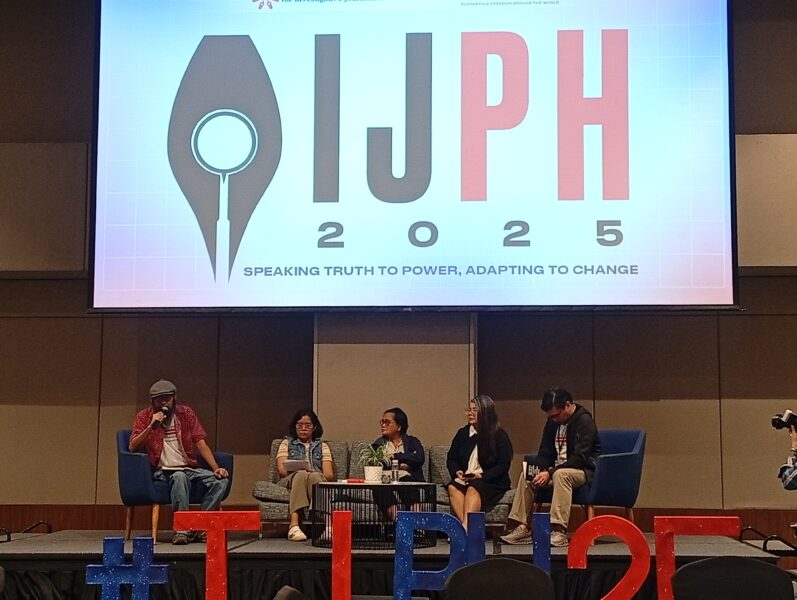
Diosa Labiste, Dean of the University of the Philippines’ College of Media and Communication, urged the journalists not to waver in advancing the tenets of “fearless reporting.”
“Let us embrace our role in society in advancing our freedom of expression and of the press,” Labiste said.
For his part, The Daily Guardian Editor Francis Allan Angelo stressed that journalists must remain “resilient watchdogs” of society and avoid “click-chasing.”
“We must go back to our communities,” he said.
As for the rise of artificial intelligence as a tool to enhance investigative journalism, Angelo advised journalists to “cautiously embrace” the technology.
“Hindi yan bolang kristal na sasagot sa lahat ng problema sa reporting. It is just tool. Do not let AI do the writing for you,” Angelo told the journalists.
Corrales concurred, expressing it succinctly: “Adapt or die.”
In his closing speech, Howie Severino, PCIJ co-founder and board of trustee, asserted that journalists should wield AI as a new weapon in upholding the truth and holding the powerful to account.
“Panahon na para kilalanin, angkinin, at gamitin ang mga teknolohiya ng bagong panahon, at gamitin ang mga ito para palakasin ang ating kakayahang maghatid ng katotohanan. Maaari, at dapat, tayong maging mas matalino, mas mabilis, mas malikhain, at mas epektibo,” Severino said.
He noted that one can observe the work of some of the journalists in utilizing big data, along with new knowledge and technology. They are able to track patterns of abuse and expose them through meaningful stories.
Because they are savvy with new platforms, Severino said, they are not content merely with writing. This approach employs multimedia to gain greater attention and deepen the impact of the journalistic work.
“Hindi tayo papalitan ng teknolohiya. Bagkus, pahuhusayin tayo nito,” said Severino.
The conference gathered journalists from across the Philippines to discuss the future of investigative journalism and called for collective efforts to sustain truthful, community-centered reporting. (With reporting from Cong B. Corrales)