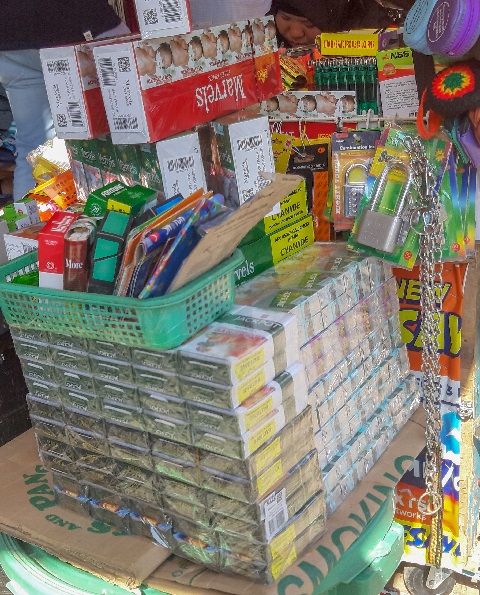
A civic group has lauded the Philippine National Police (PNP) for the historic seizure of P2.6 billion worth of illegal cigarettes but warned that the operation will be meaningless unless it leads to the imprisonment of the syndicates’ financiers.
Pinoy Aksyon for Governance and the Environment described the recent back-to-back operations in Batangas City and Malabon City as a “major breakthrough” in the fight against illicit tobacco trade.
However, the group pointed out that confiscation alone does not equal justice.
“This is not just a successful police operation, it is a wake-up call. The sheer scale of this haul confirms what many have long suspected: organized, well-financed syndicates are operating with confidence that they can evade real punishment. That must end now,” said BenCyrus Ellorin, chairperson of Pinoy Aksyon.
The P2.6 billion haul
The massive confiscation was the result of two high-impact operations. Authorities first uncovered approximately P1.1 billion worth of undocumented cigarettes hidden in abandoned trucks in Batangas City.
Hours later, a second stockpile worth P1.5 billion was discovered in Malabon. Investigators are currently probing whether a single coordinated network orchestrated both shipments.
Government agencies, including the Bureau of Customs (BOC), indicated the record-breaking seizures likely involve a large-scale smuggling ring.
“These were not random shipments. This was industrial-scale smuggling,” Ellorin said adding “industrial-scale crimes require industrial-scale punishment.”
Testing the new law
Pinoy Aksyon is urging authorities to apply the full force of the Anti-Agricultural Economic Sabotage Act (RA 12022). Under this law, smuggling tobacco products is classified as economic sabotage, a non-bailable offense.
The penalties are severe: mandatory life imprisonment for cases involving tobacco valued at P10 million or more, and fines up to five times the value of the illicit goods.
“When drivers or caretakers are arrested but financiers walk free, the message is clear: crime pays,” Ellorin noted.
The group cautioned against letting the case fade after the initial press briefings.
They cited a Senate Ways and Means Committee hearing last year that revealed glaring gaps in enforcement:
- Bureau of Customs (2018–2025): 1,296 seizures recorded, but only two convictions.
- Bureau of Internal Revenue: 1,636 seizures recorded, with only one secured conviction.
- Economic and Health Sabotage Beyond the legal battle, the group highlighted the economic damage. The P2.6 billion in illegal goods represents massive lost excise tax revenues — funds earmarked for Universal Health Care and social services.
Ellorin also warned of the health risks, noting that smuggled cigarettes bypass safety regulations and often contain unknown, harmful additives.
“The damage is two-fold: our economy bleeds, and our people suffer,” Ellorin said.
According to the group, enforcement must not stop at the checkpoints; instead, justice must reach the boardrooms and backrooms where these operations are planned.
Pinoy Aksyon also called for the immediate destruction of the seized items to prevent them from re-entering the market through back channel sales.
As the PNP begins tracing the registered owners of the trucks and warehouses involved, Ellorin framed the investigation as a definitive test of government resolve.
“This case is a test of political will,” he said.