FOR legal observers in Mindanao accustomed to the Philippines’ “humanitarian bail” system, where advanced age often secures temporary freedom, the ruling delivered last Friday, Nov. 28, from The Hague was a sharp reality check.
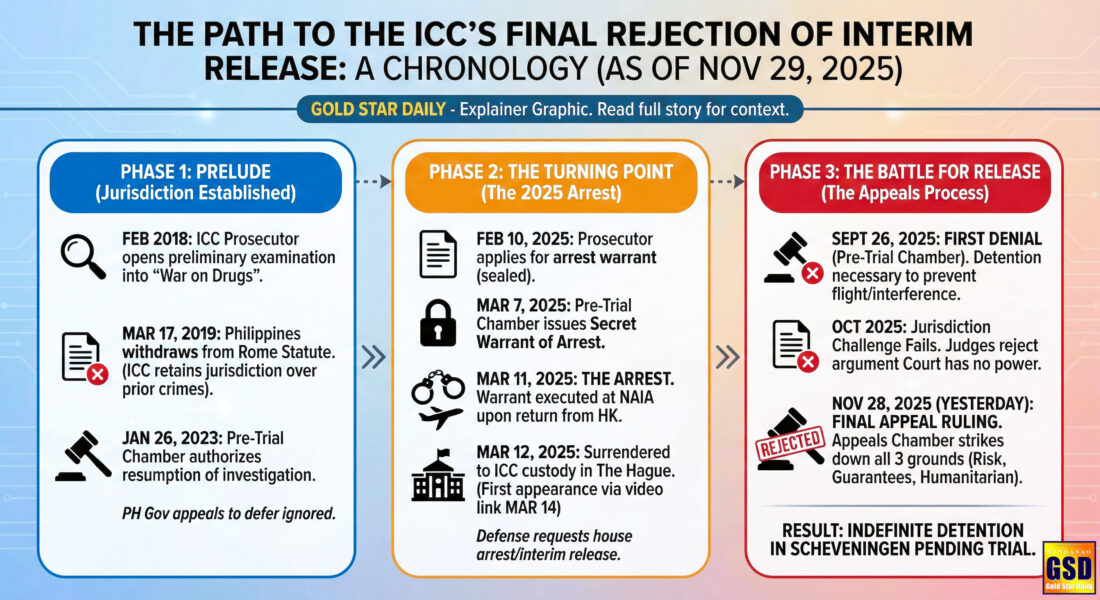
The International Criminal Court (ICC) Appeals Chamber has denied former President Rodrigo Duterte’s request for interim release, affirming his continued detention in Scheveningen.
The decision was formalized in the Judgment on the appeal of Mr. Rodrigo Duterte against the decision of Pre-Trial Chamber I, published officially on the ICC website late Friday.
The decision has left many asking: Why was the 80-year-old former president denied the same leniency he might have received in a Philippine court?
To understand the ruling, one must look “under the hood” of the Rome Statute, specifically Article 58, which operates on mechanisms vastly different from domestic law.
The ‘third rejection’
The Appeals Chamber dismissed all three grounds of Duterte’s appeal in what international press, including the Associated Press in their Nov. 28 dispatch from the Netherlands, are calling the “third rejection.”
The defense had argued that the lower court erred in assessing flight risk, ignored state guarantees, and failed to apply humanitarian considerations properly.
However, according to the official text of the judgment, the five-judge panel adhered strictly to Article 58(1)(b) of the Rome Statute.
Unlike the Philippines’ discretionary approach to bail for non-capital offenses, the ICC mandates detention if release would obstruct the investigation or endanger proceedings.
The pillars of detention
Under the Rome Statute, interim release — what is locally known as bail — is not a right if specific risks are present. In the written ruling released Friday, the Chamber identified three non-negotiable risks:
Risk of Flight: Despite defense assertions regarding his health, the judgment notes that Duterte’s “network of supporters” and substantial financial resources provided him the means to abscond, regardless of his physical frailty.
Obstructing Proceedings: The Court cited a significant risk of witness intimidation. As noted in related reporting by ABS-CBN News on the same day, this concern is central to the prosecution’s argument given the systemic nature of the “War on Drugs” charges.
Continuing Crimes: The judges found a plausible risk that the accused could continue to instigate crimes similar to those charged if released into a non-secure environment.
Why ‘humanitarian grounds’ failed
In the Philippines, the Supreme Court’s ruling in Enrile v. Sandiganbayan popularized the doctrine that advanced age and poor health are sufficient grounds for bail.
The ICC operates on a different standard.
While Article 60 of the Rome Statute allows the Court to grant release, the Appeals Chamber clarified in Friday’s publication that humanitarian factors do not automatically override the security risks listed in Article 58.
Essentially, if the risk of witness tampering is high, no amount of medical necessity guarantees release unless the detention center itself cannot provide adequate care.
The ruling explicitly referenced a medical assessment of the detention center, stating that the ICC facilities in Scheveningen are fully equipped to manage the former president’s health needs, effectively neutralizing the defense’s primary argument.
What happens next
This ruling, documented as ICC-01/21-01/25 OA2, effectively closes the door on Duterte’s temporary freedom during the trial phase.
Proceedings will now move toward the confirmation of charges and the trial proper, with the former president appearing from the detention center.
For the Philippines, this serves as a stark lesson in international jurisprudence: The Rome Statute utilizes a “victim-centered” approach, prioritizing the security of proceedings over the personal circumstances of the accused.