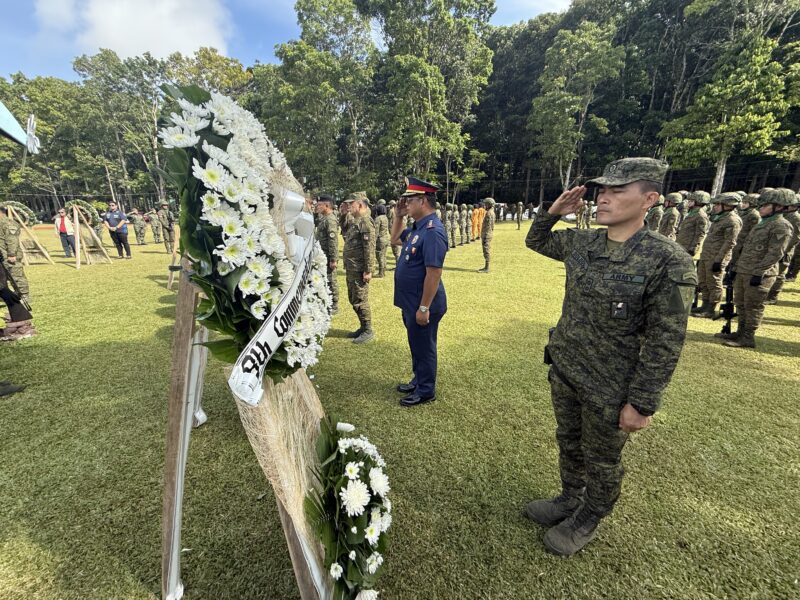
MARAWI City — In a solemn ceremony marked by remembrance and restraint, the Armed Forces of the Philippines and local officials on Monday commemorated the eighth anniversary of Marawi’s liberation from the Daesh-inspired Maute group — a victory etched in blood, rubble, and memory.
But behind the speeches of triumph lies a quieter story — one of restricted access, controlled narratives, and the journalists who once chronicled the country’s fiercest urban battle now questioning what was left unseen.
Broadcast journalist Ed Lingao, who covered the five-month siege in 2017, recalled that Marawi was unlike any previous conflict he had witnessed.
“It used to be that journalists had unlimited access and a front-row view of the battlefield. Marawi was different. The military forbade access,” Lingao said.
Instead, reporters were confined to daily press briefings at the Lanao del Sur provincial capitol, their dispatches dependent on photos, videos, and updates provided solely by the military.
“In the old days, all an enterprising journalist had to do was befriend a unit commander and tag along. That’s what we did in Basilan and Sulu. What we got were unfiltered stories. Marawi changed that,” Lingao added.
Photojournalist Fernando Sepe Jr., former deputy editor of ABS-CBN News, echoed Lingao’s frustration.
He said soldiers manned every entry point into the besieged city, barring reporters from areas where fighting raged.
“Sometimes they’d bring a few of us in — but only to the cleared zones,” Sepe said in a phone interview.
He added: “We heard the gunfire, but we were nowhere near the battle. In the morning, we’d be told what happened — but how could we verify it?”
Sepe lamented that the press was effectively reduced to spectators, confined to the capitol that had become the government’s de facto media center.
“The press failed to serve its role as the eyes and ears of the public,” he said.
House Deputy Majority Leader and Lanao del Sur Representative Zia Alonto Adiong, who served as spokesman of the Lanao del Sur Crisis Committee during the siege, defended the restrictions.
“As far as I know, there was no censorship. Access was denied for the safety of journalists, not to hide the truth,” Adiong said.
Adiong said the crisis committee worked with the AFP to provide regular updates, photos, and videos documenting rescue efforts and civilian evacuations.
Eight years later, the echoes of war have faded, but questions about transparency — and the price of security — continue to shadow the city once reduced to ruins.