(First of the three-part series)
STATE auditors have flagged the city government for “major deficiencies” in its operations, citing a P3.1-billion backlog in infrastructure projects and significant discrepancies in its asset records.
The findings are detailed in the 2024 Annual Audit Report (AAR) by the Commission on Audit (COA-10), which was received by the Mayor’s Office on June 27, 2025. The comprehensive review outlines systemic delays in the city’s infrastructure program and raises concerns over financial controls.
In a transmittal letter to Mayor Rolando Uy dated May 28, 2025, COA-10 Regional Director Mathew Rey M. Magno detailed nine major audit observations.
The audit was supervised by State Auditor V Marilou C. Mampao and led by State Auditor IV Atty. Farouk M. Dadayan.
The P3.1-billion infrastructure backlog
Auditors painted a grim picture of the city’s infrastructure roadmap. As of Dec. 31, 2024, the team reported that 241 infrastructure projects — totaling P3.167 billion — were not completed within their contract time.
Delays ranged from a few days to 1,991 calendar days, a lag of more than five years.
According to the report, the root causes include:
“The lack of effective coordination with relevant government agencies and private entities, coupled with failure to thoroughly assess the technical viability of the projects and conduct comprehensive detailed engineering during the feasibility and preliminary engineering studies.” [Observation No. 16, Book I, p. 178]
Additionally, 108 projects valued at P740.6 million had not even started construction.
“The extensive delays across various categories of infrastructure projects — ranging from roads and flood control to school buildings and water systems — indicate substantial issues in project management, planning and execution,” the report states. [Observation No. 16.4, Book I, pp. 178-179]
Auditors cited administrative hurdles as key factors, including lack of permits, unresolved Road Right of Way (RROW) issues, and the failure to relocate informal settlers.
Deterioration in loan-funded facilities
The audit specifically flagged defects in major loan-funded health and education facilities.
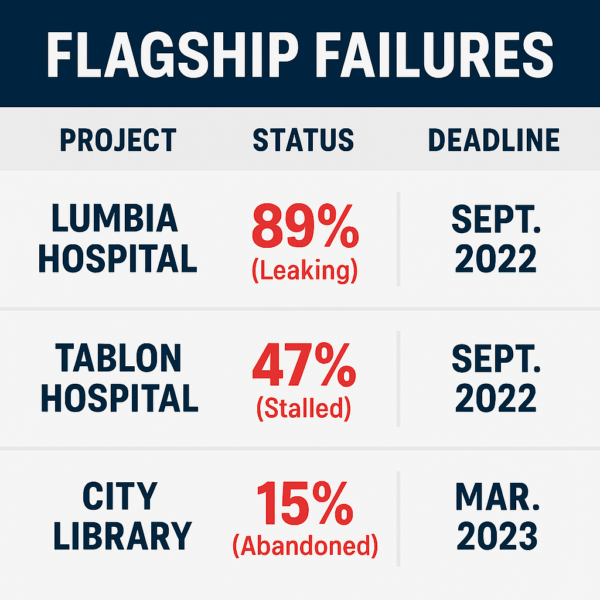
Lumbia Hospital: Despite being reported as 89% complete, the facility was flagged for “early deterioration.” Auditors observed incomplete fire exits, rust on steel frames, and water leaks.
Tablon City Hospital: Reported at 47.21% completion, but auditors found zero activity at the site.
“This project was delayed, with no construction materials or labor present on-site during inspection,” the audit team noted. [Observation No. 12.32, Book I, p. 164]
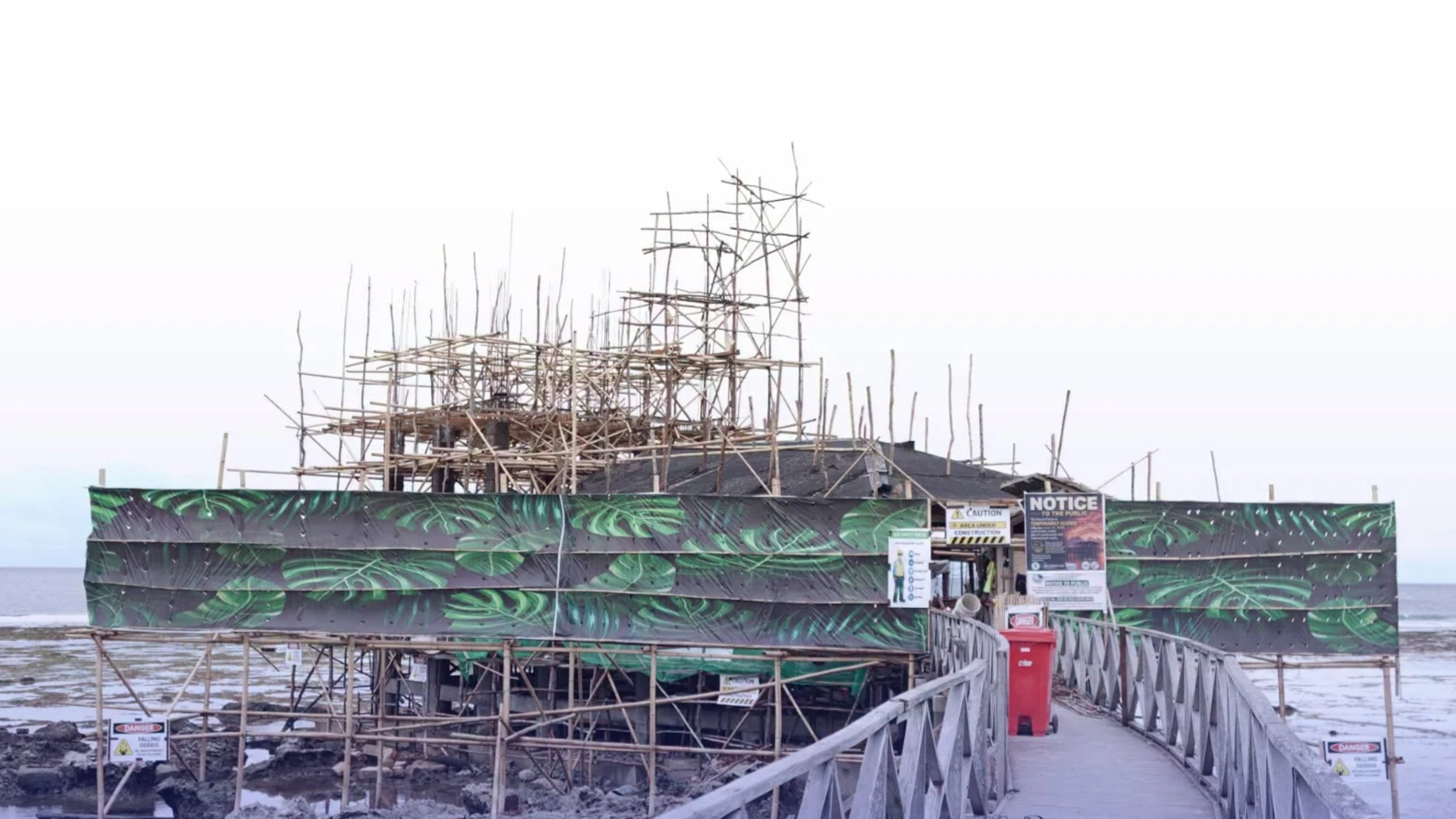
City Library and School Building: The P399.9-million project remains unfinished with only 15% accomplishment. Auditors noted the contractor appears to have “abandoned or halted construction activities on-site.”
A review of all loan-funded projects showed they “lacked the necessary building permits,” in non-compliance with the National Building Code.
The P1.6-billion asset discrepancy
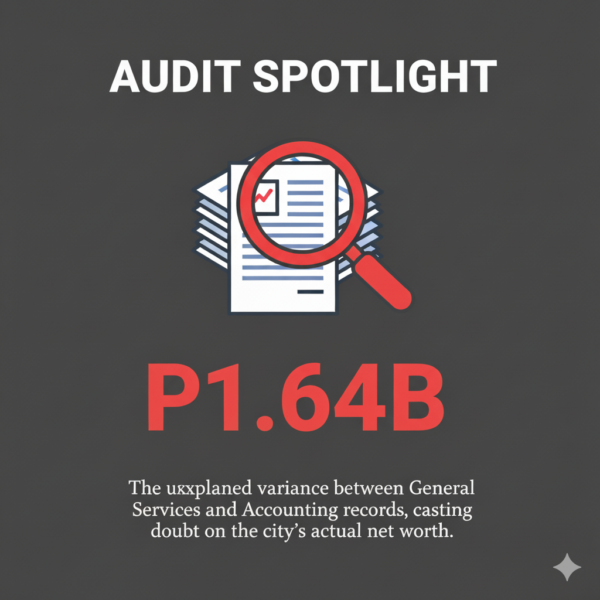
Beyond infrastructure, state auditors discovered a P1.643-billion variance between the Property, Plant and Equipment (PPE) balances recorded by the City General Services Office (CGSO) and the City Accounting Department (CAD).
“As a result, questions arise regarding the efficiency and effectiveness of asset management practices. This, in turn, casts doubt on the reliability and accuracy of the PPE accounts, consequently impacting their fair presentation in the financial statements,” the audit reads. [Section No. 6, Book I, p. 110]
Physical counts revealed missing assets and record-keeping errors:
Unaccounted Assets: P8.336 million worth of items, including 13 motorcycles, six service vehicles, and eight computers, could not be located.
Unrecorded Assets: Conversely, 48 items found in city offices were not recorded in the books.
Misclassified Funds: Completed projects were still classified as “Construction-in-Progress,” misstating specific accounts by P1.102 billion.
Unliquidated Property: P141.1 million in unserviceable property — including 128 motor vehicles — remained unliquidated between 2022 and 2024.
Procurement bottlenecks
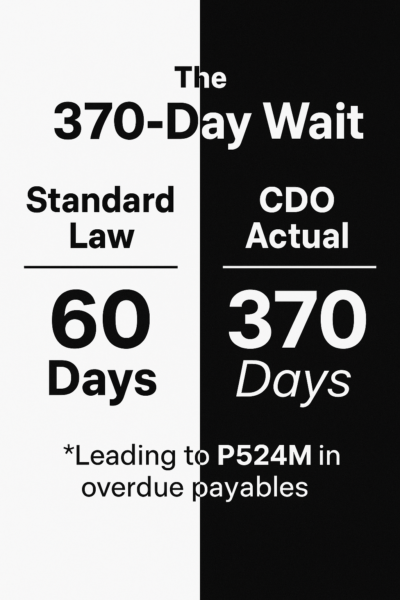
The audit also identified a sluggish procurement cycle, which now averages 370 days, far exceeding the standard 60-day limit. This bottleneck has created a P524.1-million backlog of unpaid obligations.
Crucially, auditors flagged payments processed without complete documentation. The city reportedly recognizes payables based on Purchase Orders, often lacking the required Inspection and Acceptance Reports (IARs).
In the Special Education Fund (SEF), 75% of items recognized as payables —totaling P21.78 million — were undelivered at year-end.
Finally, the report noted the city failed to maintain key procurement documents required under RA 9184, such as Project Procurement Management Plans (PPMP) and Annual Procurement Plans (APP), for several infrastructure contracts.
(This is the first in a series of reports on the Cagayan de Oro City audit findings,
covering the Calendar Year ended December 31, 2024.)