Editor’s Note: All findings cited in this report are based solely on COA’s Annual Audit Report for CY 2024.
(Last of a three-part series)
STATE auditors have flagged the Cagayan de Oro City Government for the “extremely low” utilization of critical development funds and a costly breach of loan conditions that resulted in millions of pesos in avoidable interest payments.
In this final installment of the audit review for the Calendar Year 2024, Commission on Audit (COA-10) findings point to idle funds intended for development and disaster response, alongside a breakdown in basic administrative functions — from unremitted employee benefits to public documents stored in sacks.m unremitted employee benefits to public documents stored in sacks.
Idle development funds
For 2024, the city allocated P500.14 million for its 20% Development Fund (DF), which is earmarked for infrastructure and socio-economic projects.
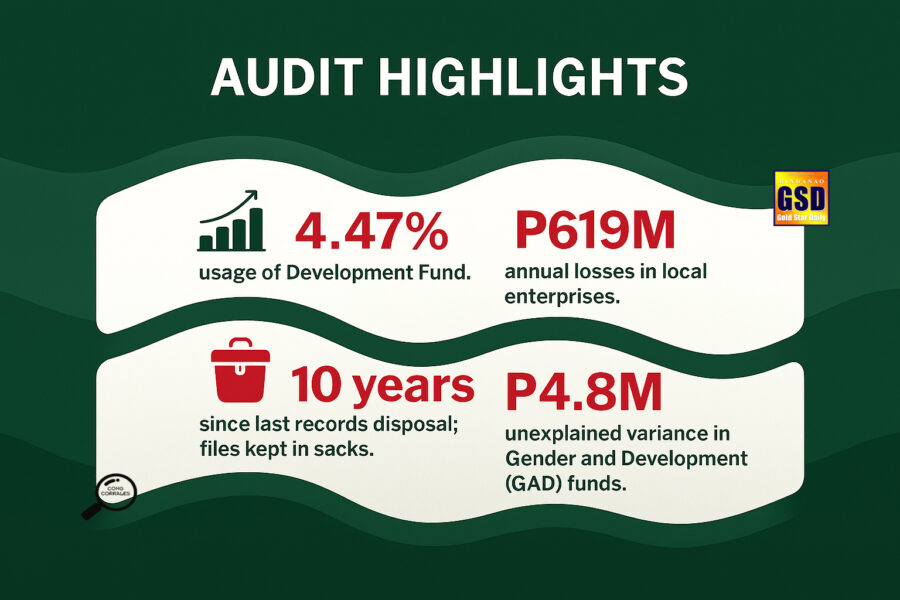
However, by year-end, the city had disbursed only P22.33 million. Auditors calculated this as a 4.47% disbursement rate.
The report noted this as an “extremely low disbursement rate,” which indicates delays in project implementation, limiting the delivery of essential services, and preventing the community from fully benefiting from planned socio-economic and environmental improvements.
Similarly, the Local Disaster Risk Reduction and Management Fund (LDRRMF) posted a utilization rate of only 23.87%.
This left P370.75 million (76.13%) unutilized, while another P328.636 million in trust liabilities remained idle.
Auditors also found that an unused balance of P8.5 million dating back to 2019 has not been reverted to the General Fund as of Dec. 31, 2024. This violates the five-year reversion rule mandated by Section 21 of RA No. 10121.
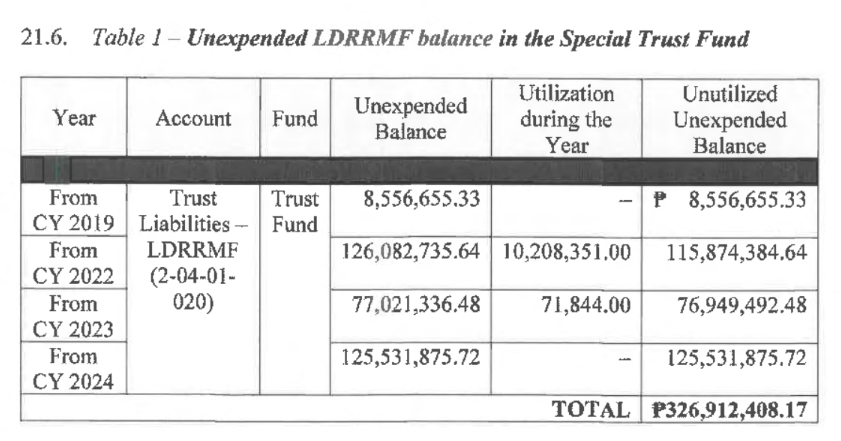
The mandatory five-year reversion rule requires that any amount of the LDRRMF still not fully utilized after five years shall revert back to the general fund and become available for other social services identified by the Local Sanggunian.
The non-reversion of the 2019 balance indicates lapses in monitoring and limits the availability of funds for other essential government social programs.
“Management acknowledged that these funds have yet to be reverted to the General Fund and committed to their inclusion in the upcoming supplemental budget for CY 2025. This non-adherence indicates lapses in the monitoring of the implementation and utilization of the LDRRMF Special Trust Funds, resulting in the non-reversion of the unutilized balances to the unappropriated surplus of the General Fund after the prescribed five-year period” [Observation 21, Par. 21.8, p. 212, Book I].
P14M penalty on loans
The audit also flagged a 171.82% spike in interest expenses for the city’s P1-billion loan.
This loan was executed on April 26, 2021 — during the term of former Mayor Oscar Moreno — to fund the Covid-19 response. However, the management of the loan conditions falls on the current administration.
In 2023, the city paid P8,215,867 (at a 2.85% rate) in interest. In 2024, the payment ballooned to P22,332,100 (at rates ranging from 6.40% to 7.11%).
The report attributes this increase to the city’s failure to maintain the required deposit balance ratio (ODB to OLB) stipulated in the loan agreement.
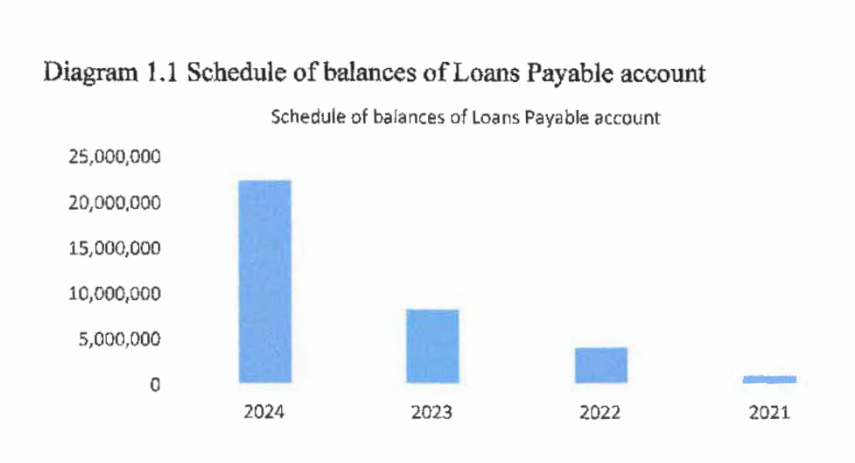
This breach of covenant triggered a penalty clause, removing the preferential interest rate of 2.85% and imposing a higher rate of 7.11%.
“The City incurred a significant 171.82 percent increase in interest expense because of non-compliance with Section 3.1 of the loan agreement, which could be considered an unnecessary expenditure and contrary to COA Circular No. 2012-003” [Observation 12, p. 156, Book 1].
Under Section 4.1 of COA Circular 2012-003, state auditors define unnecessary expenditure as “expenses which could not pass the test of prudence or the diligence of the good father of a family, thereby denoting non-responsiveness to the exigencies of the service.”
“It also refers to expenditures that is not essential or that which can be dispensed with without loss or damage to property,” the audit circular adds.
The ‘Klarexville’ issue
Auditors also flagged public projects that bear the name of the incumbent local chief executive.
On April 1, 2024, state auditors revealed that they received a letter-complaint regarding the naming of a housing project “Klarexville I, Pagatpat Valley Residences.”
Under COA Circular No. 2013-004, the commission classifies the display of pictures, images, logos, initials, or other symbols associated with the top leadership on government projects as “Unnecessary Expenditures.”
Based on this classification, the commission states that the official may be required to refund the money used for the signage or branding personally — thereby disallowing the cost.
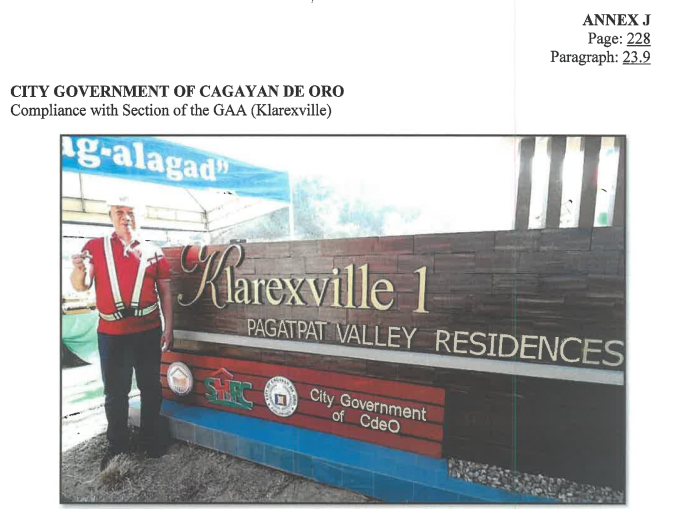
The audit team also cited Section 19 of the General Appropriations Act of 2024 (RA 11975), which prohibits affixing the name, image, or likeness of public officials to government projects.
Meanwhile, the Department of the Interior and Local Government Memorandum Circular No. 2010-101 explicitly bans naming government projects (or placing signages) that bear the names, initials, or images of incumbent officials.
Under this memorandum circular, project signages must only contain the name of the project, its location, cost, and the official seal of the local government unit.
The report revealed that the City Government recognized the audit findings and agreed during the exit conference to implement the audit recommendations, which included considering changing the name of the housing project.
“We recommended that the City Mayor strictly follow the guidelines set in COA Circular No. 2013·004...and consider changing the name of the housing project at Barangay Pagatpat” [Observation 23, Par. 23.11, p. 228, Book I].

Administrative breakdown: Unremitted benefits
Beyond the financial findings, COA confirmed lapses in basic housekeeping.
The audit team revealed that the City Government failed to remit a total of P29,926,857.93 in employee contributions and loan payments to the Government Service Insurance System (GSIS), Philippine Health Insurance Corporation (PhilHealth), and Home Development Mutual Fund (HDMF).
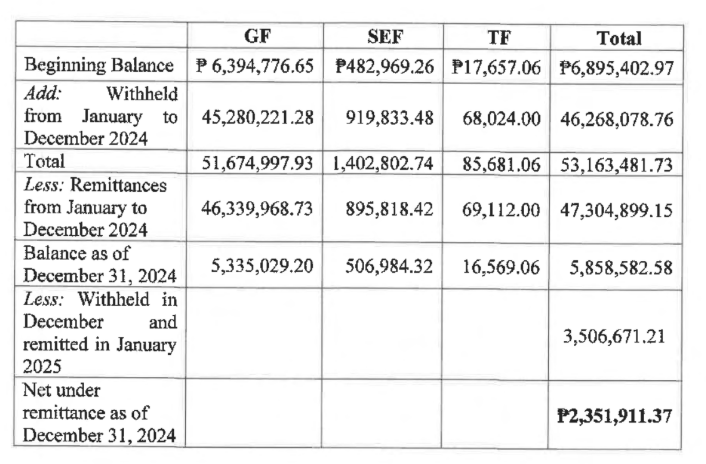
“Monthly contributions and payments deducted from payroll... amounting to P12.594 million (GSIS), P14.980 million (PhilHealth) and P2.352 million (HDMF), respectively remained unremitted as at year end (2024).” [Observation No. 19, p. 200, Book I].
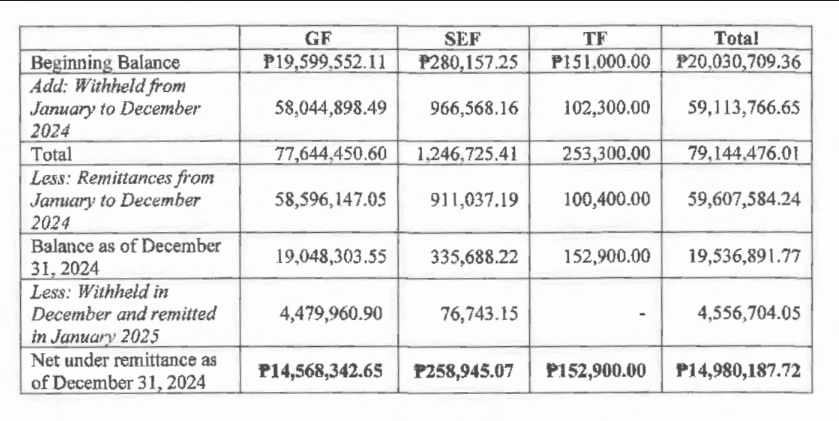
Auditors noted that the city failed to reconcile “clarificatory items” in the GSIS electronic billing system. Regarding PhilHealth and HDMF, the unremitted balances stemmed from contributions rejected by the agencies’ systems due to inaccurate member information.
“This is an indication of an existing practice of the City to remit only the partial amounts of contributions withheld” [Observation No. 19.26, p. 206, Book I].
Auditors flagged the poor condition of the City Archives, noting the city has not conducted a disposal of valueless records since 2011.
Public documents were found stored in sacks, exposed to elements, and susceptible to “deterioration, loss, and damage.”

The audit revealed that the City Government’s Archives is not compliant with the National Archives of the Philippines Act of 2007 (Republic Act 9470).
Sections 16, 17, and 18 of RA 9470 mandate that local government units must create their own archival systems; all government offices must notify the NAP Executive Director about any public records that have historical significance and have been in existence for 30 years or more; and that all government offices must physically transfer their archival records to the National Archives for permanent preservation.
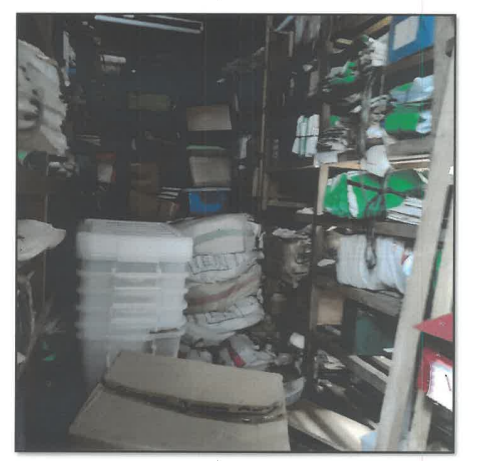
“The City Archives of the City Government of Cagayan de Oro did not comply with the records disposal standards mandated under Sections 16, 17 and 18 of Republic Act No. 9470...caused by critical deficiencies in staffing, equipment, and storage, which resulted in improper storage, accumulation of obsolete records, and lack of secure disposal for confidential records” [Observation 17, p. 193, Book I].
GAD fund discrepancies
The audit cast doubt on the accuracy of the city’s Gender and Development (GAD) reporting.
Auditors found a net variance of P4,855,817.92 between the expenses recorded by the City Accounting Department and the amounts declared in the GAD Accomplishment Report.
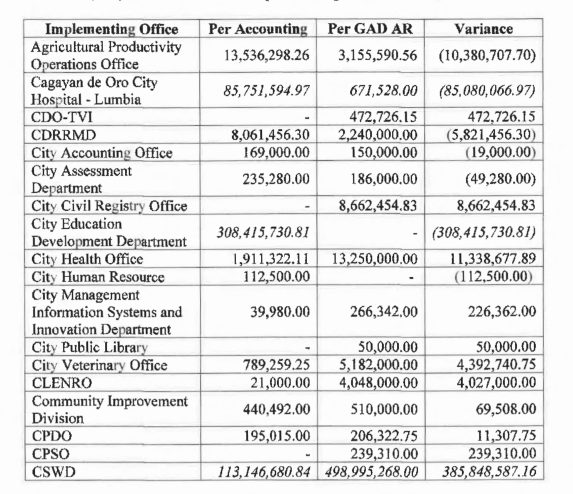
This discrepancy indicates a failure to properly reconcile the utilization of the mandatory 5% GAD budget allocation.

The auditing team stated that because the GAD data were “not identifiable and verifiable,” they were impeded from conducting a comprehensive audit of the funds.
“Without regular updates and a thorough collection of sex-disaggregated data, the database becomes limited in its ability to monitor progress toward gender focused goals. The lack of maintenance can lead to outdated or inaccurate data leading to missed opportunities for addressing emerging and incoming or future gender issues" [Observation 22, Par. 22.14, p. 224, Book I].
Economic enterprises in the red
Finally, the auditors further noted that the city’s Local Economic Enterprises (LEEs) — including public markets and terminals — lack Five-Year Business Plans or Feasibility Studies.
The report revealed that the practice of establishing LEEs without business plans and feasibility studies dates back a decade. These LEEs include the city’s public markets, terminal, and J.R. Borja General Hospital (JRBGH).
“This issue extends to newer LEEs such as the Lumbia Hospital, Tablon Hospital, and City College” [Observation 10, Par. 10.27, p. 142, Book I].
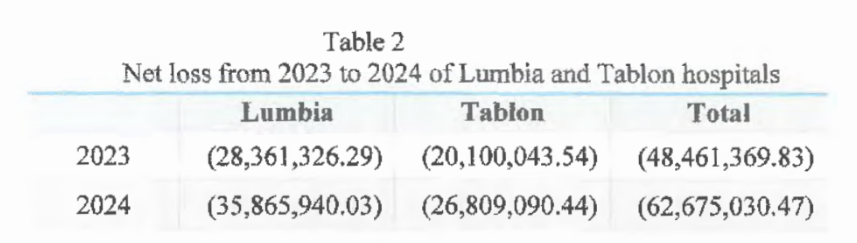
From 2015 to 2024, most LEEs incurred net losses, with deficits reaching P619.09 million annually.
During these years, state auditors revealed that the city’s LEEs — including Cogon Market, Carmen Market, Bulua Market, Puerto Market, Westbound Terminal, Eastbound Terminal, JRBGH, and Lumbia Hospital — posted “consistent financial losses.”
Additionally, the failure to include rent escalation clauses in 25-year lease contracts has effectively reduced the city’s real rental income by 31% due to inflation.
“By 2024, this gap had widened significantly. The difference between the nominal and real rental income had increased to P112,362, which now represented 31% of the nominal total. This 31% difference highlights a substantial shift over the 13-year period, reflecting the cumulative effect of inflation” [Observation 11, Par. 11.16, p. 150, Book I].
(This is the final installment of the Gold Star Daily review of the 2024 COA Audit Report for Cagayan de Oro City. Gold Star Daily has reached out to the City Mayor’s Office for a statement regarding these findings and is awaiting a response.)
To read the first of this first-part series: COA flags Oro: P3.1B in stalled projects, ‘unreliable’ asset records
To read the second of this three-part series: 5 Oro officials hold P74M in unliquidated cash: COA flags ‘systematic failure’