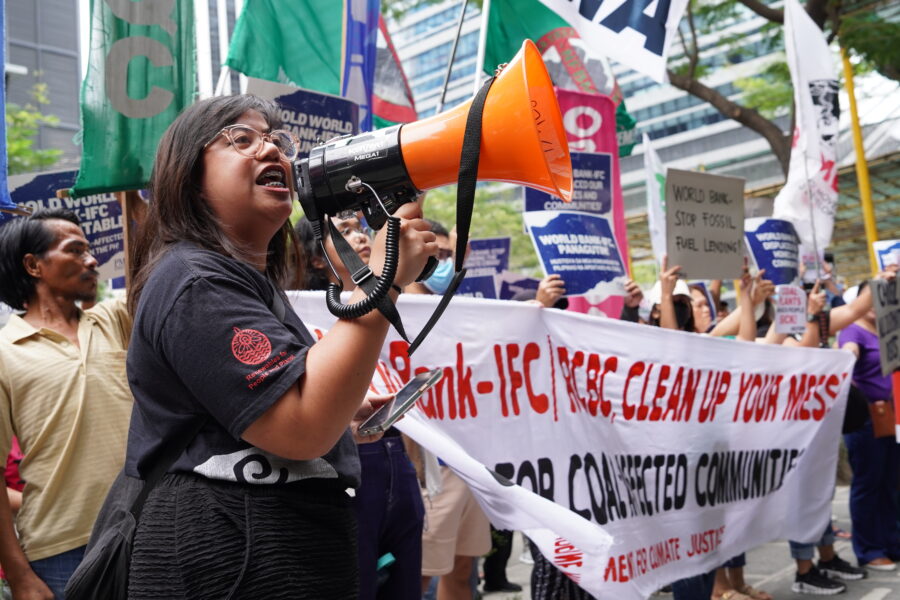
THE Philippine Movement for Climate Justice (PMCJ) held a lightning rally outside the World Bank office in Taguig on April 21, to demand accountability for coal projects financed by the bank’s private sector arm, the International Finance Corporation (IFC).
The action coincided with the first day of the 2025 Spring Meetings of the World Bank Group and International Monetary Fund (WB-IMF).
PMCJ reiterated its call for the IFC to provide remedies to Philippine communities affected by 19 coal-fired power plants financed through the Rizal Commercial Banking Corp. (RCBC), an IFC financial intermediary.
These coal-fired power plants include Sarangani Energy Corporation Plant (Kamanga Power Station) in Maasim, Sarangani; Kauswagan Power Station in Kauswagan, Lanao del Norte; San Miguel Consolidated Power Corporation Plant (Malita Power Station) in Malita, Davao Occidental; GNPower Mariveles Coal Plant Expansion and GNPower Dinginin Coal Plant in Mariveles, Bataan; South Luzon Thermal Energy Corporation (SLTEC) Units 1 & 2 in Calaca, Batangas; Quezon Power Plant in Mauban, Quezon; Panay Energy Development Corporation Plant in Iloilo City, Iloilo; Limay Power Plant in Limay, Bataan; and Therma Visayas Energy Project in Toledo City, Cebu.
The complaint was first filed in 2017 by PMCJ, Recourse, and Inclusive Development International (IDI) with the Compliance Advisor Ombudsman (CAO).
In 2021, the CAO found IFC in violation of its own performance standards. The following year, IFC adopted a Management Action Plan (MAP) pledging to assess and address the harm caused by its investments. However, as of April 2025, communities say no tangible remedies have been delivered.
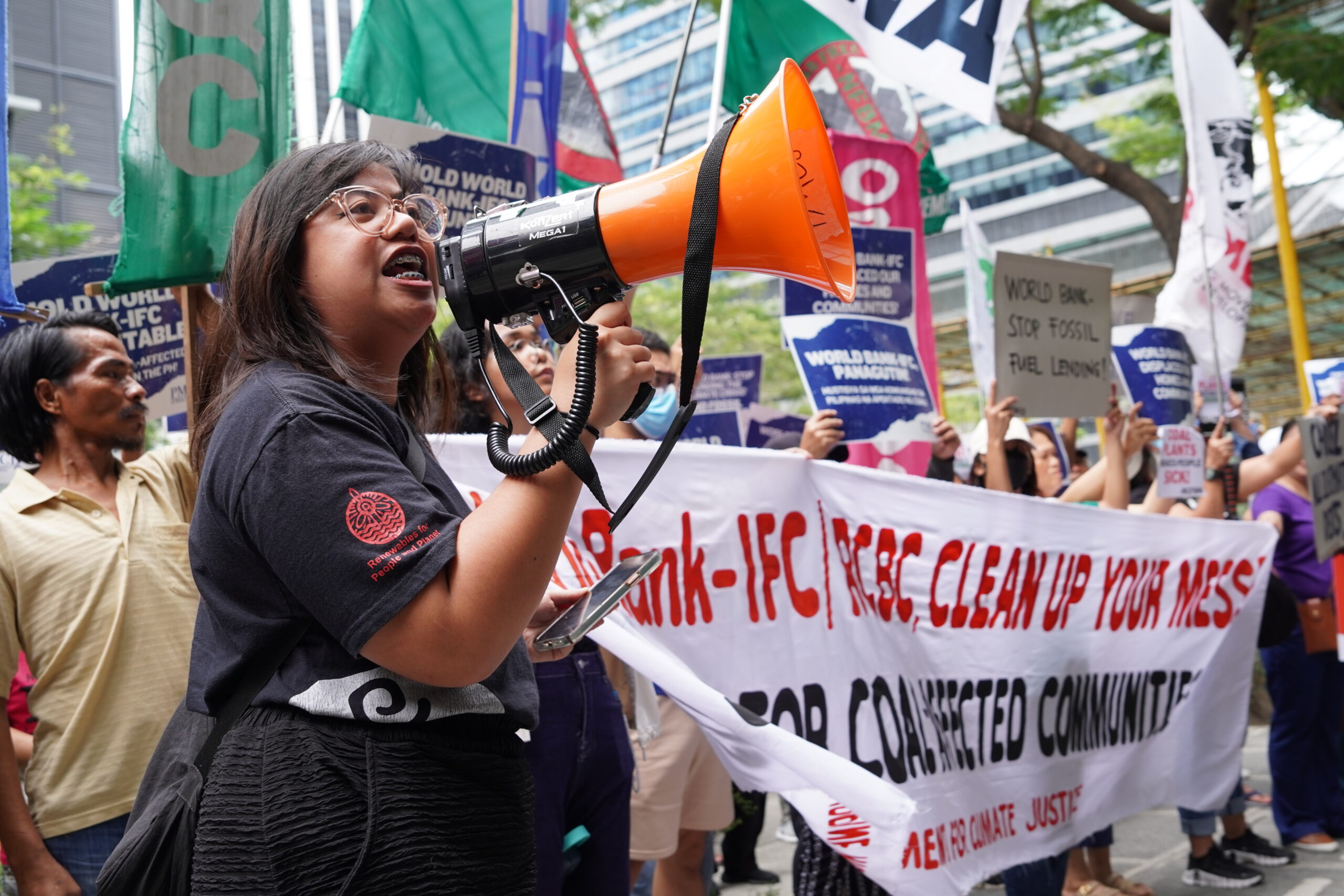
During the rally, representatives from affected communities in Bataan joined PMCJ and other civil society groups to raise banners and share testimonies about the health, environmental, and economic impacts of coal operations. PMCJ also submitted a letter to the World Bank office listing its demands.
“The World Bank-IFC must believe that dragging this out for seven years will exhaust us. But every delay only strengthens our resolve. Our fight for justice will continue as long as our communities suffer,” said Ian Rivera, PMCJ national coordinator.
In January 2025, PMCJ, Recourse, and IDI criticized the release of a CAO report, alleging a cover-up due to the omission of investigative findings and other relevant case information.
As in past years, PMCJ sent representatives to the Spring Meetings to press for reparations.
“Seven years into the process, IFC continues to deny accountability by relying on a self-serving interpretation of both the CAO findings and its own consultants’ studies,” said PMCJ legal counsel Aaron Pedrosa.
“The affected communities demand action, not more studies. Of more than 180 recommendations made to address the adverse impacts, few have been implemented.”
Pedrosa cited a January 2025 CAO Monitoring Report noting that many of IFC’s consultant recommendations remain unfulfilled. He pointed out that a coordinated “One World Bank Group” approach is needed and that only political will, not resources, is lacking.
Affected residents also spoke out.
“We are against the coal plant because many of us are getting sick. My husband can’t work because of his heart condition, and my child has pneumonia. We don’t even have a health impact assessment. These plants should not be built without thinking of people’s livelihoods and health,” said Lany Caraat of Dumlog, Toledo City.
In September 2024, Toledo City residents filed a petition against the expansion of Aboitiz Power’s Therma Visayas, Inc. plant, demanding compliance with legal requirements, including health impact assessments.
Four years ago, the CAO determined that IFC violated performance standards.
IFC approved the MAP in February 2022, followed by progress reports and community visits. But according to PMCJ, community input has been sidelined.
“From IFC’s perspective, it has no obligation to address the harms caused by its sub-projects,” said Ellenor Bartolome, PMCJ senior executive officer. “Communities have been denied access to the process and the reports they contributed to.”
Bartolome said one of PMCJ’s current demands is the release of an updated MAP that reflects worsening conditions. She also criticized the World Bank’s new Remedy Framework for not applying retroactively.
“Our message is clear: ensure accountability and deliver remedies for legacy cases like the RCBC complaint. We reject the IFC’s narrow interpretation of its responsibilities, which only deepens the suffering of affected communities,” she said.