A major education advocacy network is calling for an independent investigation after the Philippine Army allegedly exposed kindergarten-aged children to high-powered firearms and combat gear during recent “educational tours” at a military base in Bukidnon.
However, the military defended the activity, characterizing it as a supervised community learning visit meant to introduce children to “community builders and public servants.”
The Save Our Schools (SOS) Network has urged Department of Education (DepEd) Secretary Juan Edgardo ‘Sonny’ Angara to probe the 89th Infantry ‘Makatao’ Battalion. Between November 2025 and January 2026, the battalion hosted child development center pupils and dependents of the Barangay Peacekeeping Action Team at their headquarters in Maramag, Bukidnon.
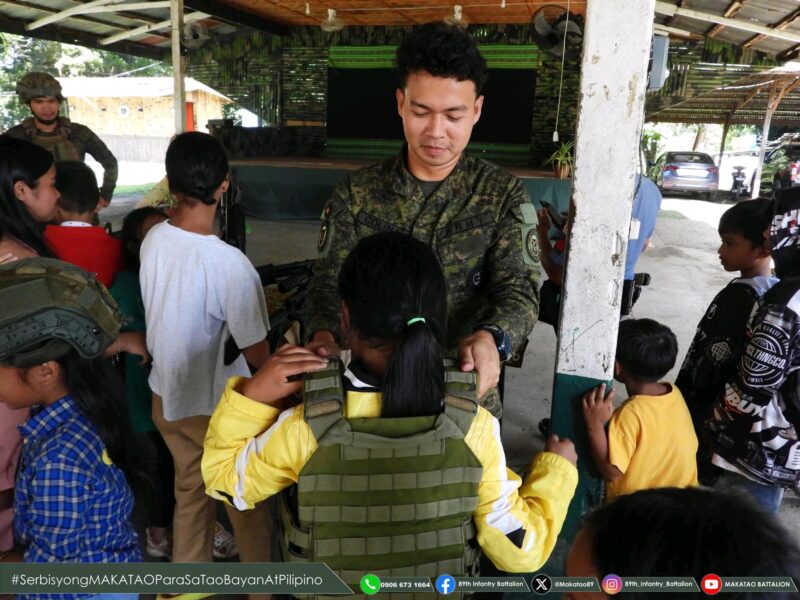
Photographs released by the military show young children gathered around high-powered weapons while soldiers explain the gear. In one photo, a soldier fits a child with a tactical combat vest. Additionally, on Jan. 15, the military conducted a “Culture of Security” lecture inside the Bukidnon State University – Kitaotao Campus.
“This is not abstract civic instruction or symbolic engagement,” the SOS Network said in a statement. “It is the direct exposure of children to weapons, military gear, and armed authority in a setting defined by combat and security functions.”
‘Community builders’
The 10th Infantry Division (10th ID), which oversees the 89th IB, maintained that the activity was initiated by the Child Development Center of Barangay North Poblacion and was conducted with the consent of parents, teachers, and local authorities.
Major Ruben L. Gadut, spokesperson for the 10th ID, said the visits were part of a broader educational tour that included stops at police and fire stations.
“This activity was not military training, recruitment, or an effort to promote violence. No live weapons were used, and all interactions were conducted under close supervision and in accordance with existing child-protection and safety guidelines,” Gadut said.
Addressing the photos of children handling military gear, Gadut explained the context.
“The presence of military equipment in the background should not be misconstrued as exposing children to violence,” the Major said.
Gadut explained that the images reflect a static and controlled display, similar to educational visits at police or fire stations. He noted that the exhibit was intended to provide age-appropriate awareness of the tools used by public servants, rather than to normalize or glorify their use.
A dangerous double standard
Despite the military’s assurances, the SOS Network warned of a “clear and dangerous pattern” of militarizing civilian education spaces, particularly in Indigenous and rural communities.
The group contrasted the military’s access to schools with the recent conviction of the “Talaingod 13” — a group of Lumad volunteer teachers and advocates who were criminalized for evacuating children during intense military operations.
“Care is criminalized. Control is normalized,” the group stated. “This is how counterinsurgency embeds itself in civilian life.”
Introducing weapons into early childhood education risks normalizing fear and violence, the group argued, adding that military presence in Mindanao communities has historically placed Indigenous children in grave danger.
“Claims that soldiers are ‘child-friendly’ collapse when measured against the lived consequences of militarization in Indigenous and Moro communities,” the network noted.
Gadut reiterated that the Armed Forces of the Philippines remains committed to upholding children’s rights.
“The AFP continues to review and strengthen its community engagement activities to ensure they are appropriate, safe, and sensitive, especially when involving young learners,” Gadut said.
The SOS Network is urging DepEd, the Commission on Human Rights, and the Council for the Welfare of Children to ensure compliance with Republic Act No. 11188, which declares children as “Zones of Peace.”