By ERWIN MASCARIÑAS,
Correspondent
BUTUAN City – Two replicas of the ancient balangay boats returned here for the Christmas and New Year holidays after successfully participating in the kick-off ceremony for the 500-day countdown to the 500th anniversary of the Battle in Mactan in Cebu City.
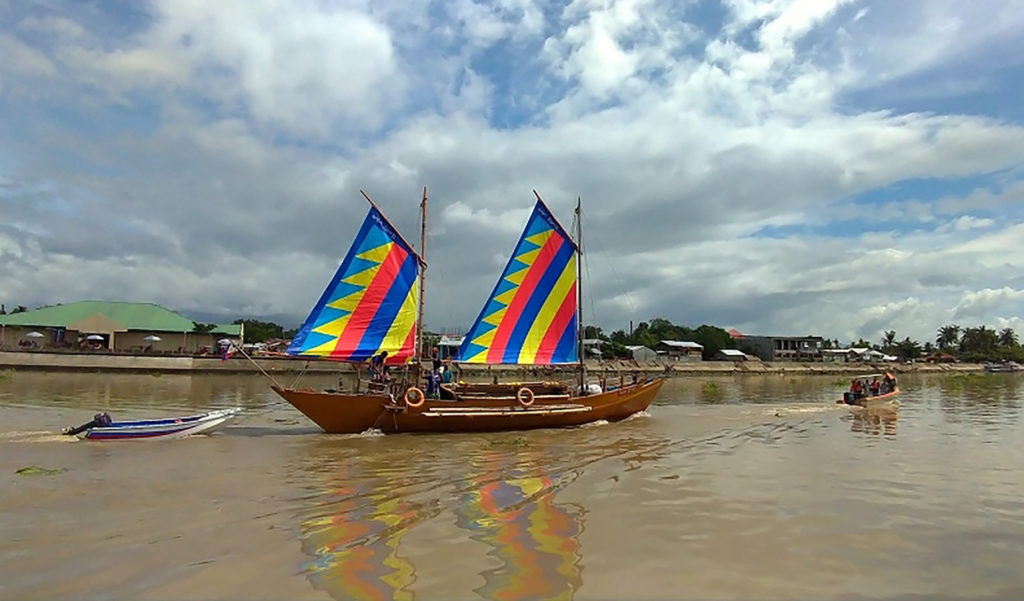
After a grueling trip from Palawan and hiding from Typhoon Tisoy in Panay, the two boats Raya Siyagu and Raya Kolambu, named in honor of the King of Mazaua and King of Butuan, participated in the celebration on Saturday to mark the historic victory in Mactan on April 27, 1521.
The boats arrived at the port of Nasipit Dec. 17, and on Dec. 20. The city government of Butuan officially held a welcome program in honor of the visit.
The boats left Cebu in the morning of Dec. 15, passed the island of Limasawa towards the Gatigan-Maasin area in the northwest, the same way Magellan’s galleons passed Limasawa from the northeast to go to Mazaua in the southwest of Homonhon and Suluan, Samar, said Jody Navarra, Butuan Global Forum Inc.’s project chair of the Mazuau Hong Butuan replica Southeast Asian voyage in 2009.
Heading the visit to Butuan City is Arturo Valdez, who commissioned the construction of Sama Tawi-tawi boat replica in 2009 and spearheaded both the South East Asian voyage in 2010 and the Xiamen, China voyage in 2018.
A born adventurer, Valdez was also the expedition leader of the First Philippine Mount Everest Expedition team in 2006.
“I’ve been spearheading the efforts of resurrecting the seafaring spirit of our forefathers among our fellow Filipinos for more than 10-years now. Now I am back here in Butuan City, the home of the balangays to hopefully stir the conscience and revive the pride, and remind everyone here that the balangay is a Butuan boat and that Butuan is the balangay,” said Valdez.
Valdez said the historic balangay boat is something that the people in Butuan could be proud of given that nowhere in the Philippines can a boat this old can be found.
“A boat found only here in Butuan is evidence that one time in history, Butuan was a center of trade and commerce in this part of the world long before the arrival of the Spaniards. We have a boat that precedes even the Viking ships,” Valdez said.
According to Valdez, Viking boats were dated 7th or 8th century while the balangays were dated around 4th century AD.
Archeologists agree that the balangay boats were used by our ancestors to maintain trade relations with neighboring islands near the archipelago as well as empires around Southeast Asia during the 10th and 11th centuries.
The flotilla of the balangay boats was accidentally discovered by treasure hunters back in 1976.
Navarra said the visit is significant in efforts aimed at preserving the archeological sites.
BGFI, Navarra’s group, raised funds to build a previous balangay, Mazau Hong Butuan, which took part in the Southeast Asian voyage in 2009.
This Dec. 4, 170 lawmakers voted to approve on 3rd reading House Bill No. 4953 to declare the balangay as the “National Boat.”
As the balangay boat was the first-ever wooden watercraft excavated in Southeast Asia. It is proof of early Filipinos’ boat-building expertise and seamanship during pre-colonial times.
“The balangay boat should be one of our national symbols. We are hopeful because of the early approval [of the bill] on the 3rd and final reading unlike in the last Congress. This time, the Senate has ample time to study the bill and discuss it,” said Rep. Lawrence Fortun of Agusan del Norte, principal author of the bill.
“Building the balangay and sailing it in the high seas entails solidarity and harmony among boat-builders and seafarers. It is for this reason that it is now used by the Philippine government as a term to refer to the smallest political unit, now popularly known as barangay. It is a symbol of the Filipino community’s character of unity, cooperation, determination, and resilience,” said Fortun.
In 1987, then-president Corazon Aquino issued Presidential Proclamation No. 86, declaring the balangays found in Butuan as “national treasures,” and the sites where these balangays were found, as archeological sites in accordance with the Cultural Properties Preservation and Protection Act.
In 1976, the historic pre-colonial balangay boats were discovered in Butuan City. Initially, a team from the National Museum counted nine boats but in 2012, a new boat was discovered underneath a previously discovered boat.
But only five boats had been dug up from the two sites in Barangay Libertad, Butuan, and the most complete is on display at the National Museum in Manila.
In 2014, the excavations stopped due to financial constraints. The research also stopped due to right-of-way and land ownership issues.