AMAI MANABILANG, Lanao del Sur — On April 14, a quiet but powerful shift transformed a province where firearms have long defined tradition, security, and conflict.
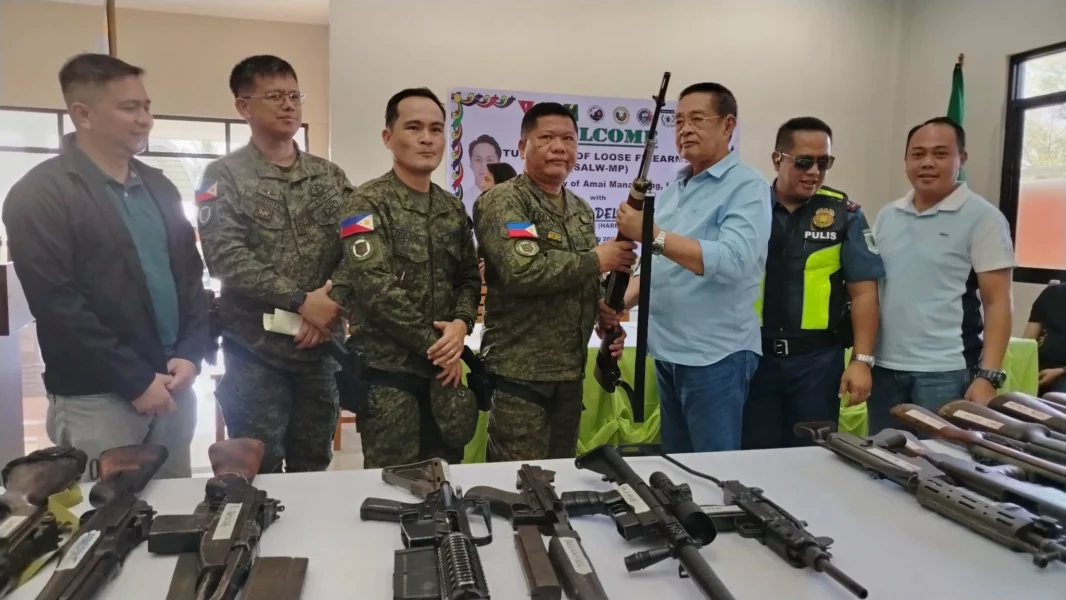
Community leaders, soldiers, and residents gathered not for confrontation, but for cooperation—laying down loose firearms not in defeat, but in hope.
The event marked the municipality’s first-ever turnover of loose firearms under the Small Arms and Light Weapons Management Program (SALW-MP), a government initiative aimed at reducing armed violence while opening pathways to livelihood.

Read also: Army raid busts terror arms factory in Lanao Sur
For many, it was more than a ceremony—it was a turning point.
Brig. Gen. Billy O. Dela Rosa, commander of the 103rd Infantry (Haribon) Brigade, called the effort a shared commitment to a safer future.
“In every gun surrendered, there is a life potentially saved,” he said.
“Sa isang putok ng baril, may isang ina na umiiyak at may isang anak na nawawalan ng ama.”
In Lanao del Sur, where rido or clan feuds can escalate quickly, firearms often serve as protection—but also fuel cycles of violence. This makes initiatives like SALW-MP both sensitive and necessary.
What sets the program apart is its human-centered approach. The program exchanges surrendered firearms for livelihood packages equivalent to their assessed value.
A rifle can become a motorcycle, a small business starter kit, or tools for income—practical support that helps families rebuild.
Lt. Col. Jerry Doldol, commanding officer of the 55th Infantry Battalion, said the shift goes beyond numbers.
“These firearms are no longer symbols of fear,” he said. “They are proof that communities are choosing peace.”
Local leadership proved crucial. Under Mayor Saidamen Leo Manabilang, and with the support of traditional leaders, the municipality fostered dialogue and trust—key to encouraging participation.
Amai Manabilang is now the first in the area to host such a turnover, setting a model for neighboring communities.
Vincent B. Parreñas of the Office of the Presidential Adviser on Peace, Reconciliation and Unity (OPPAPRU) emphasized that peacebuilding is a shared responsibility.
“It requires the collective effort of every community member,” he said.
Authorities are also tracking the program’s impact, particularly on rido, by gathering data across municipalities to see if reduced access to firearms leads to fewer conflicts.
The community now breathes a sense of relief as peace takes hold.
Without the constant presence of weapons, movement becomes freer, and opportunities begin to return. Hopes for education, stable livelihoods, and peaceful coexistence feel more attainable.
Sultan Mastura Manabilang underscored the role of education in sustaining peace, calling it the foundation of long-term progress.
He noted that the town—formerly Bumbaran—once had only one elementary school but has since expanded access to education, producing professionals such as doctors, engineers, and lawyers who contribute to community stability.
Sustaining the program will require continued trust and coordination. But in Amai Manabilang, a meaningful first step has been made.
Here, the exchange is simple but powerful: firearms for futures, fear for hope, and conflict for community.