Journalist safety training in the Philippines has expanded and become more professional over the past decade, but critical gaps remain — especially in mental health, gender-based risks, disaster and conflict coverage, and long-term program support — according to a new scoping study that will anchor a national safety trainers’ guide.
The publication, Journalist Safety Training in the Philippines: Strengths, Gaps, Recommendations, compiles Phase 1 findings of a three-stage project led by the Asian Institute of Journalism and Communication (AIJC) from June to August 2025. The effort is supported by International Media Support (IMS) and funded by the European Union and Denmark’s Ministry of Foreign Affairs.
The study draws from desk research on training efforts dating back to 2006, four focus group discussions in Metro Manila and Cagayan de Oro, key-informant interviews, and a multi-stakeholder workshop in Quezon City.
What’s working
The report notes that current safety courses increasingly weave together ethics, local context, and multiple risk domains — physical, digital, legal, and psychosocial.
They also make greater use of participatory methods such as needs assessments, simulations, and debriefings. Programs now feature regional representation, women-only sessions, and secure participant registration. Many are facilitated by topic experts and, in some cases, resource persons from the security sector.
“Training programs reflect a comprehensive approach,” the paper says, citing modules that range from risk assessment and first aid to disaster coverage, digital security, and paralegal guidance.
The gaps
Despite improvements, the authors warn of fragmented sessions, content gaps, and tight schedules that leave little room for hands-on learning. Areas needing the most attention include safety during elections, mobile journalism, conflict reporting, mental health, and harassment and microaggressions inside newsrooms.
The report says journalist safety courses must confront “fragmented sessions and ‘misalignment’ with real-world needs.”
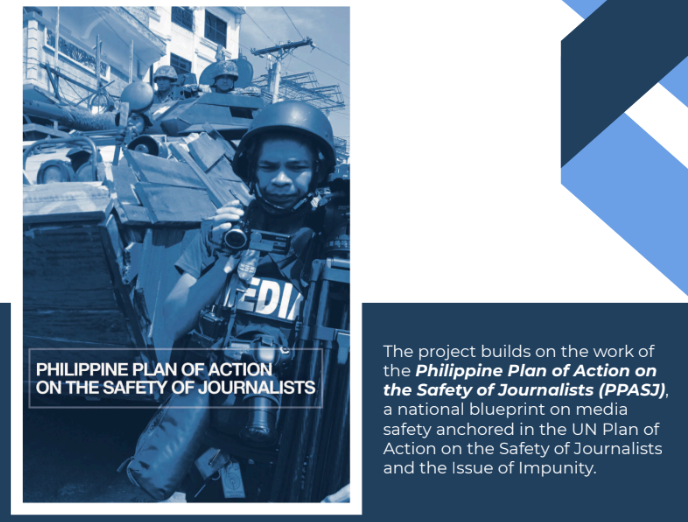
Participants also pointed to the need for a stronger grounding in ethics and legal context — from the UN Plan of Action to the Philippine Plan of Action on the Safety of Journalists. Other priorities include consistent self-defense training, culturally specific guidance for coverage in the Bangsamoro Autonomous Region in Muslim Mindanao (BARMM), and measures to prevent trauma exposure during and after training.
The way forward: a trainers’ guide
Phase 2 of the project will develop a practical safety trainers’ guide built on a core module that embeds freedom of expression, cultural awareness, and intersectional concerns — including health, working conditions, generational needs, and SOGIE.
Modules will stand alone but remain connected, with gender considerations integrated throughout. The guide will include teaching tools, localized safety protocols, and regional case studies.
It should also align with the PPASJ’s “4Ps: Prevention, Protection, Prosecution, and Partnerships,” the study reads in part.
Planned content includes disaster and hazardous-event coverage; digital-security updates such as anti-terror surveillance risks; simulations of legal-risk situations like arrests and subpoenas; anti-harassment protocols; and peer support with clear referral paths to mental health professionals.
How to teach it: methodology, planning
The report encourages the use of clear, simple language and case-based learning, with modules sequenced so that local “situationers” build toward national and global context. It also proposes hybrid (in-person and online) delivery, participant pairing for simulations, age-sensitive approaches from boomers to Gen Z, newsroom leaders’ involvement, and mannequins for anti-harassment role-play.
To encourage participation and improve retention, the authors urge realistic goals, staggered schedules, inclusion of underrepresented beats such as sports and lifestyle, expanded access for provincial and campus journalists, traceable certificates, and detailed security plans for venues.
Trainers, support, and sustainability
The study recommends defining competencies for basic safety trainers and trainers-of-trainers, regular updates to modules, post-training debriefs, refresher courses, and building a national roster of trainers with strong local knowledge.
It also calls for a “culture of care” to reduce burnout, minimize information overload, and avoid duplication across organizations.
Beyond the guide, the report proposes monitoring systems — including a Strategic Lawsuit Against Public Participation (SLAPP) case database — and tools to track chilling effects on journalists. It suggests aligning monitoring with UNESCO indicators and mechanisms of the Presidential Task Force on Media Security and the Philippine Press Institute’s Media-Citizen Councils.
Long-term results should include procedural or policy reforms and improved newsroom safety protocols.
“Journalists would benefit from refresher sessions and advanced modules,” the report notes, pointing out that safety trainings remain “few and far between.”
What’s next
Phase 3 will involve pretesting and pilot rollout of the trainers’ guide before wider dissemination.
For AIJC and its partners, the goal is clear: a reusable, locally grounded toolkit that strengthens journalist safety standards nationwide and reinforces the country’s broader media freedom commitments.