MARAWI City — Lanao del Sur has become the first province in Southeast Asia to house the UNESCO “Tree of Peace,” cementing its transformation from a 2017 battleground into a global symbol of resilience.
The bronze sculpture was formally turned over to Governor Mamintal ‘Bombit’ Alonto Adiong Jr. at the Provincial Capitol Complex on Nov. 29. The handover follows Adiong’s recognition as a Gusi Peace Prize International laureate for 2025, honoring his peace and development initiatives in the province.
Created by UNESCO Goodwill Ambassador Hedva Ser, the ‘Tree of Peace’ is an emblem promoting education, culture, and unity. Marawi now joins a prestigious list of locations hosting the monument, including Harvard University, Temple University, and sites in France, Germany, China, and Uzbekistan.
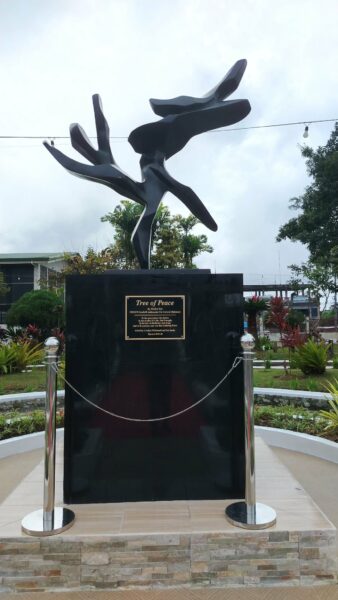
During the unveiling, Adiong emphasized the profound symbolism of installing the artwork in a city that is still healing.
“Today, we unveil not only a sculpture but a powerful symbol of hope,” Adiong said. “Its installation here in Marawi carries deep significance. Our city, once devastated by the siege in 2017, stands today as a testament to resilience — rebuilt through the strength of our people, the unity of our leaders, and the unwavering spirit of the Meranaw and the entire Bangsamoro.”
‘Antidote to war’
The ceremony gathered diplomats, fellow Gusi laureates, and the artist herself. Ser described the installation as a challenge to the community to prioritize dialogue, particularly among the youth.
“This city, once the site of a terrible battle, now welcomes the world with smiles and peace,” Ser said. “Marawi is a powerful example for the world.”
UNESCO representative Cecilia Alvarez delivered an emotional message highlighting the role of women in peacebuilding, citing her own history as a “war baby” whose father was a guerrilla fighter.
“Marawi stands as a manifestation of the cruelty of war. I hate war… I don’t want children to be orphaned because of the continuing war. We have to stop this,” Alvarez said. She added that while men often create war, mothers are the world’s “best antidote,” capable of healing the earth and its people.
Proof of recovery
Viktor Sebek, Chairman of the South-South Cooperation Council and a fellow Gusi laureate, noted that Marawi’s selection as the 21st “Tree of Peace” site in the world is proof of its successful recovery.
“I have been coming to the Philippines for 28 years and have traveled across Mindanao. What Governor Adiong has done in Marawi is remarkable. It is now a perfectly safe place,” Sebek said.
UNESCO stated that Marawi was chosen specifically because it symbolizes healing and the continued pursuit of peace in Mindanao.
“May this Tree of Peace serve as a beacon for future generations — a living commitment that Marawi and Lanao del Sur will continue its path toward recovery, harmony, and lasting progress,” Adiong said.