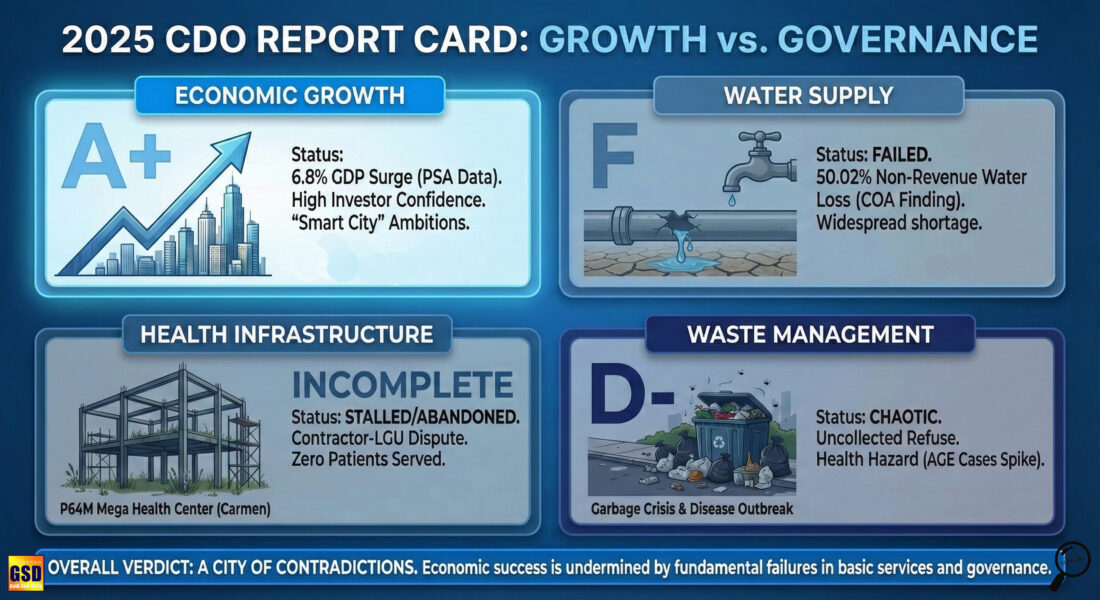
THE year 2025 has been one of sharp contrasts for Cagayan de Oro City: a 6.8% economic surge and a skyline reaching for “metropolitan” status, even as basic services struggled to keep water flowing and traffic moving.
The defining narrative of the past year was not the city's wealth, but its challenges in delivering essential services.
Economic surge vs. infrastructure gaps
Cagayan de Oro maintained its reputation as the economic powerhouse of Northern Mindanao, securing several national citations.
Data from the Philippine Statistics Authority (PSA) shows the city remains the region's top economic contributor, posting a 6.8% real Gross Domestic Product (GDP) growth and accounting for 28.3% of the region's total output.
“Private investments in housing and commercial infrastructure helped sustain construction momentum,” the PSA report reads.
Leading this boom is the "Masterson Mile" in uptown Cagayan de Oro, a multi-billion-peso township and high-rise corridor. Similarly, Vista Land’s "Midtown CDO" has emerged as one of the largest urban estates in Mindanao, integrating residential and commercial hubs.
A year of accolades
In terms of competitiveness, the Oxford Economics Global Cities 2025 Index ranked Cagayan de Oro the sixth most competitive city in the Philippines and 577th globally out of the world’s 1,000 largest urban economies. Other major 2025 recognitions included:
Innovation: Named "Most Innovative Highly Urbanized City" in Northern Mindanao by the Regional Development Council (RDC-10).
Employment: The Public Employment Service Office (PESO-CDO) was a national finalist at the 25th National PESO Congress.
Governance: Awarded the Regional Rafael M. Salas Kaunlarang Pantao Award for excellence in population management.
Finance & Safety: Received the DILG Seal of Good Financial Housekeeping and the Seal of Child-Friendly Local Governance.
Water crisis and public healthA persistent water crisis culminated in an August health advisory following a localized outbreak of waterborne diseases.
The dispute between the Cagayan de Oro Water District (COWD) and Cagayan de Oro Bulk Water Inc. (COBI) affected water supply, leading to a public health concern.
In August, the City Health Office reported a spike in acute gastroenteritis (AGE) cases in Barangays Carmen and Balulang, where residents were forced to use unprotected wells.Waste management and COA audit
A transition to new waste-hauling contracts in mid-2025 led to significant service gaps. By October, Mayor Rolando 'Klarex' Uy launched "Task Force Basura," a 24-hour emergency operation to clear an 8,000-cubic-meter backlog.
The Commission on Audit (COA) flagged COWD's 50.02% non-revenue water (NRW) rate, indicating inefficiencies in water management.
Gridlock and infrastructure projectsThe June implementation of the Local Public Transport Route Plan (LPTRP) met with mixed reviews.
The city’s road network struggled to support increasing density, leading to severe gridlock.
The P64-million Mega Health Center in Barangay Carmen remained an unfinished project, highlighting infrastructure challenges.COA's 2024 annual audit report
The COA report revealed:
Low Fund Utilization: 20% Development Fund had a 4.47% disbursement rate.Unutilized Calamity Funds: P370.75 million.
Debt Penalties: P14-million interest penalty due to loan condition breaches.
Unliquidated Advances: Five officials hold over P74.3 million.
2026: Aligning governance with growthAs Cagayan de Oro faces 2026, aligning governance with growth remains a challenge.
The city must address issues like water loss and unfinished projects to match its accolades and ensure sustainable development.