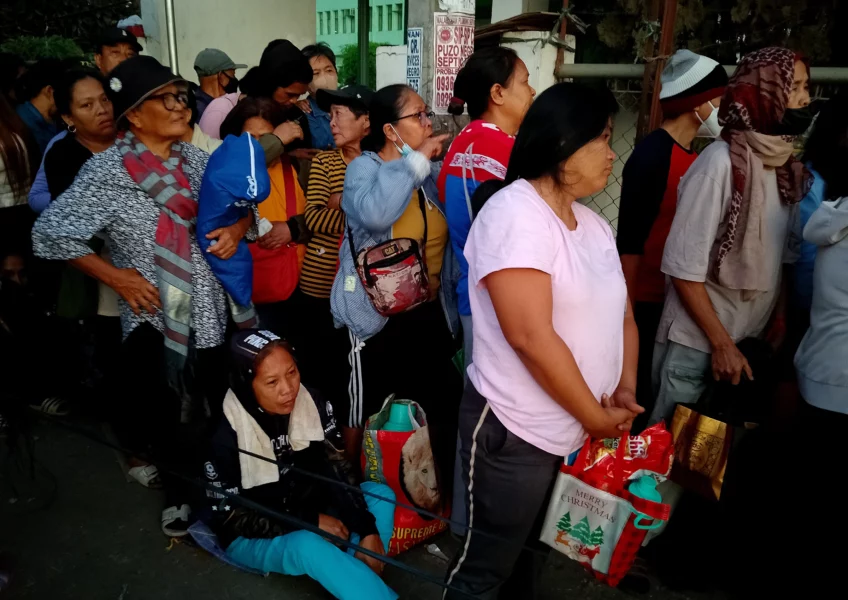
CAGAYAN DE ORO CITY — Hundreds of low-income residents, senior citizens, persons with disabilities, and minimum wage earners are spending cold nights on pavements outside the National Food Authority (NFA) warehouse in Sitio Baloy, Barangay Tablon to secure rice priced at ₱20 per kilo.
The long queues highlight strong demand for the government’s subsidized rice under President Ferdinand Marcos Jr.’s “Benteng Bigas, Meron Na” program, launched in April to make staple food more affordable for vulnerable sectors.
Demly Sobrepeña, 74, a retired mechanic, said he had been in line since 2 p.m. the previous day, joining an estimated 700 others waiting outside the NFA office.

“It’s 3 a.m. now and we are still here waiting for the NFA office to start selling,” Sobrepeña said.
“If we leave the line, somebody will take our place.”
Read also: Cheap but high quality: NFA assures standards for P20/kilo subsidized rice
Resty Calope, 34, a carpenter from Barangay Puerto, stood watch near the NFA gates as he endured the chilly early morning.
“We patiently wait here, endure the cold night, and we get only 10 kilos. Two days from now, we will line up again,” he explained.
Calope, a regular buyer, noted that the NFA limits each person to 10 kilos per week, or 40 kilos a month.
“It’s really cheap compared to commercial rice. That’s why many of us keep coming back,” he added.
For his family of five, the 10 kilos lasts only about two days.
At around 5 a.m., security guards open the gates, allowing 10 people in at a time. Inside, a lone NFA employee checks identification cards and issues coupons before buyers proceed to the warehouse to claim their rice.
Residents said only about 500 coupons are distributed daily. Once these run out, the gates are closed, and those who missed out must return and queue again.
The setup has drawn concern from the City Council, which is pushing for barangay-level distribution to ease the burden on residents.

Councilor Marlon Tabac, president of the city’s barangay association, said the centralized system has caused inconvenience, forcing vulnerable groups to endure long waits just to access affordable rice.
Eduardo Timaan, 57, an unemployed government worker, said he and his wife will continue lining up as long as subsidized rice is available.
“Rice is a staple. If we can’t afford meat, fish, or vegetables, we can at least make porridge. Without it, my children will go hungry,” he said.